
Barbaro Cacio at AUREA: Getting There Isn't the Hard Part
A holistic health coach on why the wellness world keeps you scattered, why you should stop trying to become an expert before you start, and the trap he watched himself fall into inside his own community.
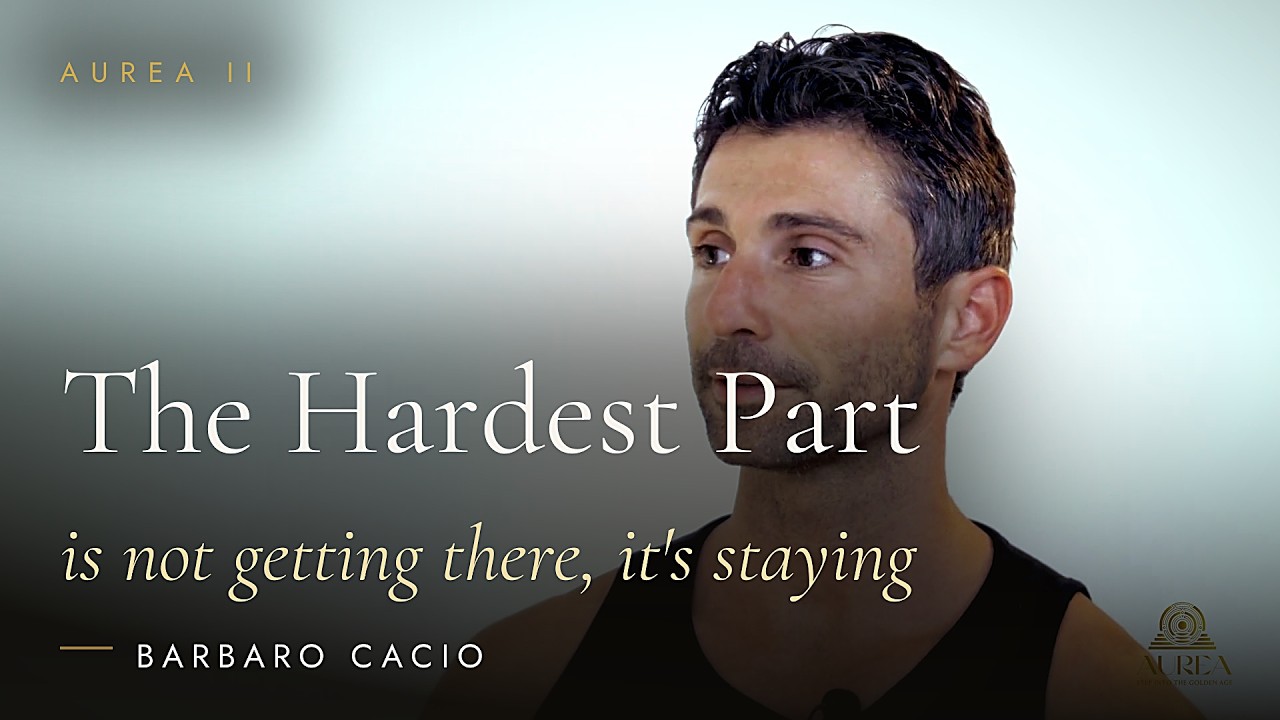
Barbaro Cacio works in holistic health: nutrition, lifestyle coaching, and the parts of the work that sit beyond the body. What he keeps returning to is not a protocol. It is simplicity, and his reason is pointed.
"We're living in an age of intense complexity. People are way too stressed about a lot of things that don't really matter in the long run and they've lost themselves."
Why feeling scattered isn't an accident
His diagnosis of why wellness feels impossible is worth hearing from someone inside it.
"When you're more focused it's pretty simple. When you're more scattered, it's, oh, I need to learn all this different stuff. This guy's saying this, this girl's saying that. It gets confusing."
And then the harder claim:
"That's on purpose. To keep us confused, and that way you end up a subordinate to some authority system instead of yourself."
Whether or not you accept the intent behind it, the effect is real and most people can verify it from their own last six months. The more inputs you take on, the less you act, and the more you look for someone to tell you what is true.
Why you should stop trying to be an expert first
His alternative is unglamorous and immediately usable.
"People try to be an expert on something in order to know how to do it when really, you just do it. And you're becoming the expert in the process."
The method is experimentation, and the discipline is in the second half of it:
"Experiment and ditch stuff quick that's not working. Move on to something that is."
He is realistic about the timeline. It may take ten or twenty attempts before someone finds the thing that actually fits them, and he does not regard that as failure. That is the search working.
Which is also why he refuses to hand people a template:
"Instead of throwing everybody into a cookie-cutter thing, I try to connect with them, then send them in a direction that can work for them."
Why change always starts with the individual
Asked what the Golden Age means to him, he gives the version that closes the loop between personal work and world-changing.
"There is no big golden age on a big scale without everyone having a golden age internally first. It starts with the I, then it goes to the we, then it goes to everything."
And he names the inversion he sees constantly:
"A lot of the world is set up so people focus the opposite way. They're trying to fix everything else, pointing the finger, and they haven't done the work."
He includes himself in the accountability, which is rarer than it should be in this field:
"I'm not somebody who just tells everybody else to do everything and doesn't do it. I like to call myself out. I like to be called out and held accountable too."
What nobody warns you about after the change works
His most useful observation is about what happens after the change works.
"Sometimes the hardest part is not to get there. It's to stay."
He describes what arrives once you are on a mission: people appearing to pull you back toward who you used to be, invitations designed for the old version of you.
"I'm like, oh God, this is a distraction test. It's called the resistance. There's always that resistance that's going to come get you when you're on a mission."
He is honest that he still falls for it occasionally, and that the falling has its own use:
"Sometimes you make the mistake of falling for it for a little bit, and you go, oh crap, I just saw what that did to me. I'm not doing that again."
He is also unbothered by the social cost. Some people will find you no fun. His answer: we all have our missions.
What he's actually working on
The most valuable thing in the interview is what he names as his own current work. It is a warning aimed squarely at his own community.
"It's a big trap when you're in the spiritual community or the holistic community. It's easy to get dogmatic."
He used to write people and situations off quickly, certain his outlook was the correct one. He describes where that led:
"I used to have a real defeatist mentality, we're all screwed. Now I try to see the good in everything. Even in the stuff I think is designed against us, I try to pull the good part out."
He is careful, too, about the perception that underpins a lot of his worldview: that much of modern life is built in ways that wear people down. He offers it as his own read rather than as fact, and notes that the more useful move now is not to catalogue the damage but to find what is workable inside it.
What he is practising instead is neutrality, and he draws the distinction that makes it usable:
"Neutrality can be looked at as being passive. That's not what I mean. It's that you're not overly attached to the outcome. It's not that I don't have an intention or an expectation; it's that I'm not so bound by it."
What to do instead of gathering more information
You do not need more information, and you almost certainly do not need to become an expert before you begin. You need one experiment, run honestly, and the willingness to drop it fast if it isn't working.
Then, when it does work, expect the pull back. Staying is the harder half, and almost nobody tells you that in advance.
Watch the full conversation above.
Frequently asked questions
Why does Barbaro Cacio think people feel so scattered and confused?
Because taking on too many conflicting inputs (this person says this, that person says that) keeps people from acting and makes them dependent on some outside authority to tell them what's true. Whether or not that confusion is intentional, the effect is real and verifiable from your own last six months.
Do you need to become an expert before you start?
No. His advice is to just start doing it, and become the expert in the process, through experimentation. He expects it might take ten or twenty attempts to find what actually fits, and doesn't count that as failure. The discipline is dropping what isn't working quickly rather than forcing it.
What happens after you actually make the change you wanted?
Staying is often harder than getting there. He describes people and old invitations pulling you back toward who you used to be, which he calls a distraction test. He admits he still falls for it sometimes, and treats each time as more proof not to do it again.
What is Barbaro Cacio working on in himself right now?
Avoiding the dogmatism he sees as a trap in spiritual and holistic communities. He used to write people off quickly with a defeatist mentality ("we're all screwed") and is now practicing neutrality: having intentions without being so attached to the outcome that he can't see good anywhere else.
Back to Wisdom