
Benjamin Zaemisch at AUREA: There Is No Arrival. Only Impeccability.
He finished the work of his life, and then spent nine months unable to write a word, because nothing changed. What he found in those nine months is the most useful thing anyone said on the AUREA stage about what to actually do with a life.
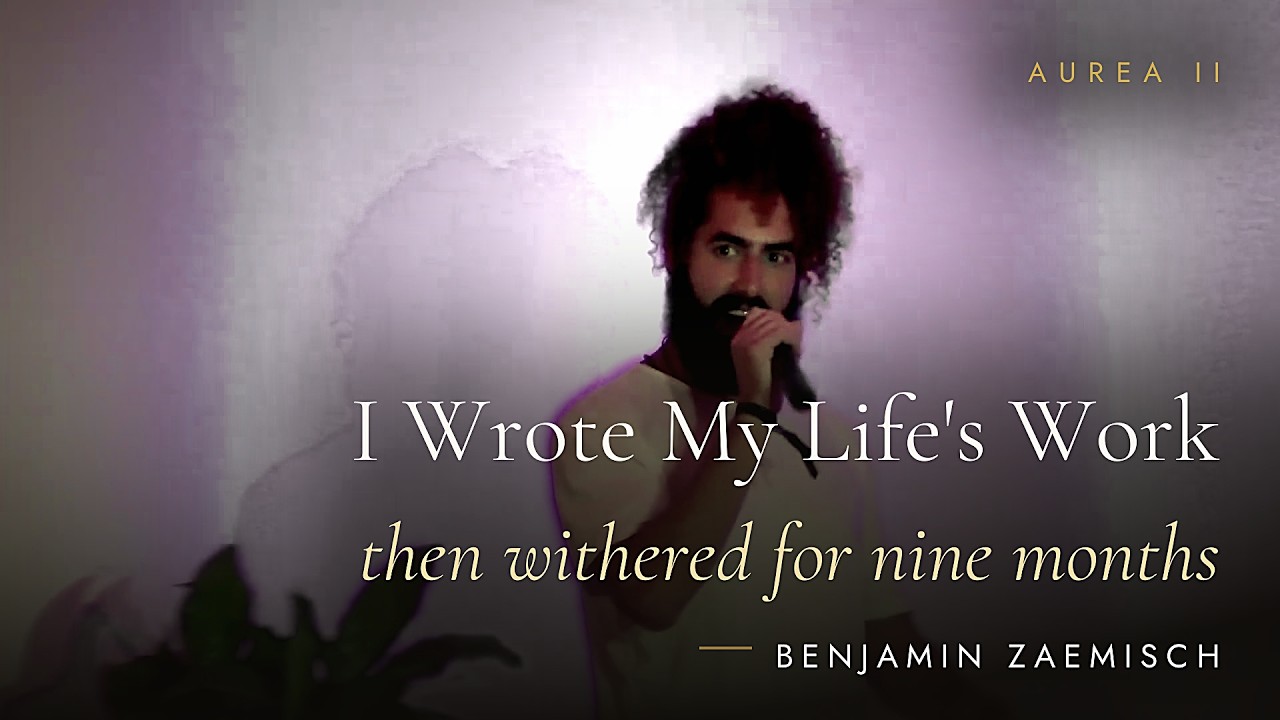
Benjamin Zaemisch told the room it was his first time on a stage, and then asked for the kind of attention you would give a bomb with a twenty-minute timer.
He earned it. This is the most useful talk of the weekend on the question underneath everything else: what are we actually supposed to do with a life?

What the shoelace parable is actually about
He opens with a parable. Northern Mexico, the late 1960s. A spiritual master and his apprentice are walking. The apprentice's shoe comes untied. They stop. When they come around the corner, they find the dust settling from a rockslide that would have killed them both.
The master takes the moment for what it is.
"There is no conceivable way for a human being to know why the shoelace came untied when it did. It is not within the domain of man to know the things controlling the fate of this journey. So tell me: what free will is actually yours?"
The answer the apprentice arrives at is the whole talk:
"The only thing in his hands was to tie his shoes impeccably."
How a childhood in an isolated community shaped him
He was born in 1986 into a community of about a hundred people in the Alaskan wilderness. He is precise about what it was:
"I wouldn't say it was a cult in my experience, but it was as close as you can get to that line without crossing it."
No television. No outside input at all. A childhood spent in the woods, organising a rich private inventory of creation.
Then, at seven, he opened a history book and saw circles over countries showing how many billions of people lived there and what they believed. He had thought his group was the only religion, because religion meant truth.
He raised his hand, assuming the others had simply missed the implication.
"So you're telling me there are billions of people all over the world who believe different things than we do, and there are a hundred of us here, and we're right?"
The teacher said yes, calmly, and kept talking.
"I packed up every cell in my being and moved it into my own head. These people have no idea what's going on, and I'm going to figure it out for myself. That turned me into a question mark. Not prone to asking questions. It turned my entire being into a question mark."
What his search for answers actually cost him
At fifteen, sitting alone outside in Wisconsin after the family had moved back to what he calls the real world, the intensity of that need to know produced something he still cannot reconcile. A timeless, world-breaking experience he describes as barely making it back to his body whole.
"I came back with a fractured psyche, and the kind of manic condition that turns your life into shackles while turning your desire into the whip of your slave master."
By his late twenties he was homeless, and (in his words, offered without euphemism and with an apology to his family for saying it out loud) selling every part of his mind, his spirit and his body in service to addictions he states plainly he is still struggling with today.
The turn came in the third year of a prison sentence, when he caught sight of a possibility that seemed worth fighting for.
After release: eight hours a day of structured kriya and hatha yoga. The Manic Serenity launched in 2019. And on 8 August 2020, the work he calls the greatest accomplishment of his life: The Eternal Testament.
What happened after he finished his life's greatest work
This is the part that makes the talk matter, and he tells it against himself.
He had assumed that finishing the work of his life would deliver something. If not humanity hoisting him onto its shoulders, then at least a path. He is disarming about the size of the expectation:
"Here's the thing about Messiah complexes. The reason I know we all have one is because I know we all have one."
Instead: nine months of withering. Not writing. His brand kept alive by his partner. Running a construction company laying fibre while the projects that meant everything to him sat untouched.
"I was crippled and paralysed by the realisation that I had bought into this myth of arrival. I let myself think that perceiving truth allows you to transcend the conditions of reality."
He had forgotten the walk in the mountains. He was still just a man. The rocks would fall where they fell. The only thing that was ever his was the shoelace. And he realised he still did not know what impeccability actually meant.

Why his mother's answer was never good enough
He had asked it before, at eight or nine, on the stairs: what are we supposed to do in this life?
She said: every day we just have to do our best.
"I have hated that answer ever since. Not because she wasn't right. Because it was so under-analysed. What does it mean to do your best? How can you know what is best for a person if you can't define the domain of responsibility that person has?"
So he spent the nine months answering it properly.
What the closed loop of clarity, integrity, and growth is
What he came back with is a cycle of three, and each one depends on the one before it.
Clarity. And his constraint on it is the humbling part:
"Clarity cannot extend beyond the season you are in. What comes in the following season depends on how you handle the season you're in. Every enlightened being thought they could enlighten the world in two years."
Life gives you more either way, he says. Do well and it destroys your plans with a catastrophe of new information. Do badly and it destroys you to stop you destroying yourself.
Integrity, which clarity depends on. And here he gives the image worth keeping:
"Integrity is a bridge. The banks are your responsibility. Without the banks, the river cannot flow. You have to control yourself to allow the universe. You have to define the banks of the river, or power can never move through you."
And crucially, no two people's integrity looks alike:
"The structural integrity of every bridge depends on the chasm it spans and the banks it is anchored into."
Your gift is on your side of the bridge. Reality is on the other. What lets anyone cross is how well you are built for your particular chasm. Which is why copying someone else's discipline rarely holds.
Growth, which integrity depends on. Where your roots are, what soil they are in, what you are reaching toward. And growth, in turn, depends on clarity. The loop closes.
"This is the entire scope of human responsibility placed in our free will. And thank God he didn't give us more than this, because this is too much. But I have to ask: if you're not doing this, what are you doing?"
Why only we have to bother
His closing argument is the one that gives the loop its weight.
A tree cannot choose its soil or what it becomes. What we call instinct in an animal is the same life expressing through a system with no choice in it. Both are already in perfect balance, and neither had to do anything to get there.
"Only the human has been given this dominion. Only the human has been given this free will. And that space is the only place in creation where our possibility of transcendence lives."
What to do with the season you're actually in
If you are waiting for the book, the exit, the launch, the recognition (the thing after which it will finally be different), Benjamin has been there and come back to report that there is nothing on the other side of it.
The rocks fall where they fall. Nobody gets to know why the shoelace came undone. What you get is the season you are actually in, the banks you are willing to build, and the shoes in front of you.
Tie them impeccably.
Watch the full talk above.
Frequently asked questions
What is the shoelace parable about?
A spiritual master and his apprentice stop when the apprentice's shoelace comes untied, and in that pause, a rockslide that would have killed them both passes ahead of them. The lesson: you can't know why the shoelace came untied when it did. The only thing ever in your hands is to tie your shoes impeccably.
What happened after Benjamin Zaemisch finished "The Eternal Testament"?
Nine months of withering, not writing, his brand kept alive by his partner while the work he thought would define his life sat untouched. He calls it realizing he'd bought into the myth of arrival: that perceiving truth lets you transcend the conditions of reality. It doesn't.
What is the "closed loop" he teaches?
Clarity, integrity, and growth, each depending on the one before it. Clarity can't extend beyond the season you're in. Integrity is like a bridge: you have to define your own banks, or power can never move through you. Growth depends on where your roots are. And growth feeds back into clarity, closing the loop.
Why does he say only humans have to "bother" with this?
Because a tree can't choose its soil, and an animal's instinct is life expressing through a system with no choice in it. Both are already in perfect balance without trying. Humans alone have been given dominion and free will, which is also the only place in creation where the possibility of transcendence lives.
Back to Wisdom