Creating a Golden Future at AUREA: A Roundtable on Regeneration and Innovation
Filmed at the Climate Innovation Hub in Miami during AUREA II, this roundtable hosted by Jonathan Barry of the Mind Lab Institute brings together a visual artist, Blue Moon Hemp founder Christopher Coward and wellness entrepreneur Scott Goldman on regenerative investment, art as the opposite of war, the morning routines they use for stress, and what artificial intelligence frees people to do.
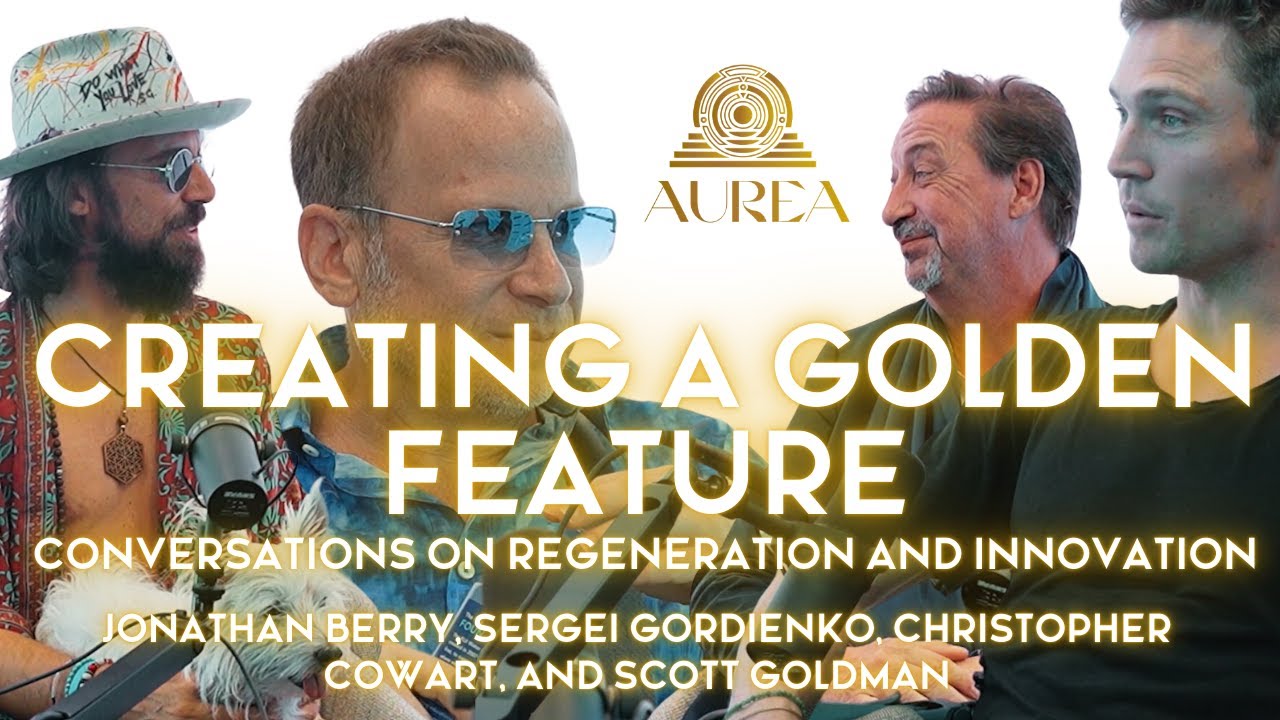
Four men sat around a table in a Miami podcast studio with no air conditioning running, and the question put to each of them in turn was what golden future they are creating for humanity. They got through art, medicine, sunlight, cancel culture and artificial intelligence before the heat ended the recording.
The conversation was filmed at the Climate Innovation Hub during AUREA II. Jonathan Barry hosted it. He introduced himself as the founder of the Mind Lab Institute, said he also works with a family office that raises money for companies and funds, and credited the developer Tony Cho with the venue and with the phrase he kept coming back to: regenerative placemaking. Around the table were a visual artist, a hemp company founder and a health and wellness entrepreneur.
What a golden future meant to the four people at the table
Barry put the same question to everyone: what is your background, and what is the golden future you are creating for humanity? He answered it first himself, in the language of capital. His work is directing investment into the companies he believes are genuinely building the regenerative movement, which puts him in the position of deciding which version of the future gets funded.
The other three answered from inside their own trades. The artist answered with a message he paints. The hemp founder answered with the intention he says goes into a product before it is sold. The wellness entrepreneur answered with two conditions he says he reversed in his own body. Nobody at the table described the golden future as something arriving on its own. They each described a thing they are already doing on a Tuesday.
Why one artist built his whole practice on two words
Sergey works under the name Do What You Love, and the phrase is the work rather than a slogan attached to it. His installations are visible across Miami, and the message on them never changes.
"I'm reminding and inspiring people to find their passion and do what they love as much as they can, as often as they can, because I think this is the most important message in the world," he said. His logic runs in a straight line and he repeated it several times through the conversation: people doing what they love are happy, happy people make the people around them happy, and that is how the world changes. When Barry asked at the end for one thing to say to someone who feels hopeless, he did not add anything new. "Just do what you love more often, as much as you can, and that's it. It's very simple."
What "putting the frequency of love into what we sell" means to a hemp founder
Christopher Coward owns Blue Moon Hemp, a plant-based CBD company he says was among the first in the space in 2016. His description of the business is that the intention behind a product is part of the product. "We like to call it putting the frequency of love in what we sell, and it's served us very well."
He means it literally enough to act on it. He told the table that the walls of the manufacturing facility are being covered in stickers carrying that messaging. He also used the table to announce a limited edition run made with the artist, hand-finished box art and a hand in the formulation, which is the moment the philosophy turned into a product launch in real time.
His larger frame came from a question he and the artist had argued over before. What is the opposite of war? His answer is art. "Art is the expression of love that is sourced from the divine feminine, and only the divine feminine can create." He extended it past creative work to any work at all: "it doesn't matter what you do as long as what you do matters." A school teacher, a bus driver, a founder. Put love into it.
How Scott Goldman says he reversed diabetes and psoriasis without medication
Scott Goldman, who posts as Life of Scotty G and runs Vape Central Group and a custom vinyl and sticker company, told the table that diabetes and psoriasis arrived in his forties out of nowhere, and that he decided to reverse them without taking medication. This is his own account of his own body, not a medical claim, and he offered it as the reason he now works in health and wellness.
His account of the psoriasis is that it started in the gut. He removed dairy, changed his diet, added exercise, and got out into the sun. He is 52. His stated method is unglamorous and daily: get your wellness in check every morning before 9am, and keep stress at the bare minimum. His closing advice to anyone watching was to follow the same routine and see what it does.
The morning practices this table uses to keep stress down
Asked what an individual can actually do, the table converged on a morning routine rather than a philosophy. Goldman's anchor is light: get outside for the first 45 minutes of the day, which he says supports the immune system and resets the body. "God gave us this light for free, no excuse not to get out there and take it in."
The artist added the practices he uses alongside it. A cold shower every morning. Walking barefoot on grass to reconnect with the earth. Standing and meditating on a nail board, which he described as a way to put down whatever you are carrying, because nothing else holds your attention while you are standing on it. Breathwork. Gratitude journaling. Coward's list ran through the kitchen: a tall glass of water with half a lemon and half a tablespoon of apple cider vinegar in the morning, no gluten, no dairy, no tap water, and fried food and sugar named as the main inflammatory offenders. "Your food directly reflects your mood." Intermittent fasting came up as a practice all of them use in some form. These are the speakers' own routines, offered as what works for them.
Whether the shift starts with educating people or with healing yourself
This is where the table actually disagreed, and the disagreement is the most useful thing in the recording. Coward and Goldman argued that education has to come first, through social media and through people willing to teach in public, because most people have no way to find this information on their own. "You've got to start the ball rolling, because not everybody can figure this out on their own."
The artist pushed back. "We don't need to educate anyone. We just need to be the best version of ourself all the time." His position is that healing yourself does the teaching, because the people around you receive it and are moved by the evidence rather than the argument. If we can, they can. Coward found the seam between the two positions and named it: it starts inside. "Find your light, share your light, be light. Find your love, share your love." He was careful to say he did not mean anything soft by it. The love he was pointing at is the one you have to extend to yourself before any of the rest of it works.
What the host thinks artificial intelligence will free people to do
Barry closed with the most concrete prediction anyone made. His view is that as AI takes over the tasks he described as pushing buttons to move a one to a zero, the time those tasks consumed comes back to the people who were doing them, and what they choose to do with it decides everything.
He called it a quickening of technology running alongside a possible quickening of consciousness, available to whoever chooses it. The old idea he referenced is that one percent of humanity meditating might tip the whole system. His question is what happens when far more than one percent suddenly has the hours. He put it in terms anyone can check against their own calendar: a world where Monday to Thursday is the working week, and Friday belongs to you, treated as a graduation rather than a loss.
The last exchange returned to the question Coward had opened with. If the opposite of war is art, and art is creation, then the thing to build is a creation culture. "I don't want to cancel anybody," he said. "We're canceling cancel culture." The artist put the whole hour into one line as the group wrapped: when you create you live, and when you live you love. It was that kind of table. A conversation about the birth of a new age ran alongside a half-time score from the Heat game and an ageing house dog wandering into shot, and none of it broke the thread.
Watch the full talk above.
Frequently asked questions
What was the Creating a Golden Future conversation at AUREA II?
A roundtable filmed at the Climate Innovation Hub in Miami during AUREA II, hosted by Jonathan Barry of the Mind Lab Institute. Four founders and creators answered one question in turn: what golden future are you creating for humanity? The conversation covered regenerative investment, art as the opposite of war, morning routines for stress, reversing chronic illness, and what artificial intelligence frees people to do.
Who took part in the roundtable?
Jonathan Barry hosted, as founder of the Mind Lab Institute and an adviser directing capital into regenerative companies. Sergey, the Miami visual artist who works under the name Do What You Love, spoke for the creative side. Christopher Coward, owner of the CBD company Blue Moon Hemp, and Scott Goldman of Vape Central Group, who posts as Life of Scotty G, filled out the table.
What does "do what you love" mean as a business philosophy?
The artist at the table treats it as a chain rather than a slogan. People doing what they love are happy, happy people affect everyone around them, and that spread is the mechanism that changes the world. Christopher Coward extended it to any job at all with the line "it doesn't matter what you do as long as what you do matters," meaning the intention you bring is the part that carries.
What morning routine did the group recommend for stress?
Get outside for the first 45 minutes of daylight. Take a cold shower. Walk barefoot on grass. Add breathwork and gratitude journaling. In the kitchen: water with half a lemon and half a tablespoon of apple cider vinegar, no gluten, no dairy, no tap water, and less fried food and sugar. These are the speakers' personal practices rather than medical advice, described from their own experience.
What did they say about AI and the future of work?
Jonathan Barry argued that as AI absorbs repetitive work, the hours it frees are the real event. He described a quickening of technology alongside a possible quickening of consciousness for anyone who chooses it, and floated a four-day working week where Friday belongs to the person rather than the employer. He framed that shift as a graduation rather than a loss.
Back to Wisdom