The Freedom Panel at AUREA: What Golden Age Leadership Actually Requires
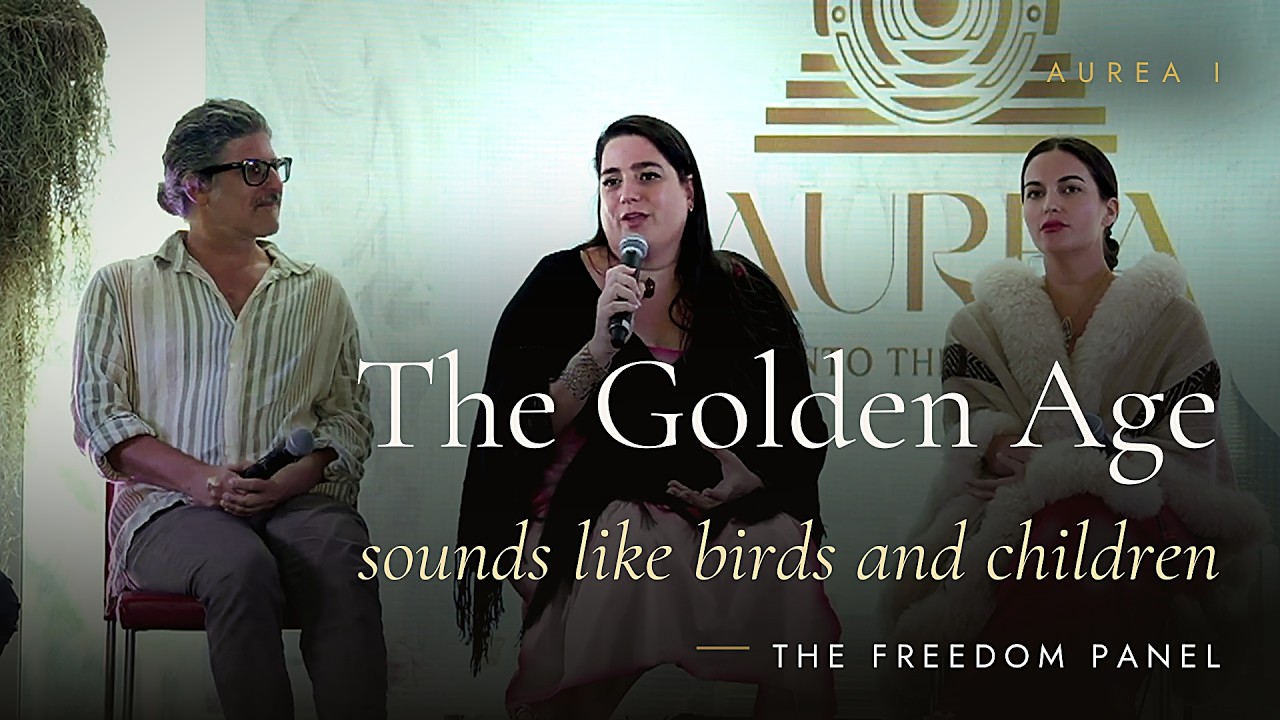
On the AUREA I stage, Sacred Economics author Charles Eisenstein, anarchist filmmaker Derrick Broze, Sacred Breath Academy founder Kaya Leigh, ethnobotanist Stephen Brooks and a Fortune 500 leadership trainer disagreed publicly about golden age leadership, defending masculine leadership, naming the gap between a leader's image and their private conduct, and describing a world whose loudest sound is birds singing and children playing.
Asked on stage what qualities of old-paradigm leadership need to go, Charles Eisenstein said "I don't really have an intelligent answer for that right now." The host waited. Eisenstein added, "Yeah, that was not a rhetorical device." On a panel convened to describe the future of leadership, the most honest thing said all hour was a refusal to perform.
The Freedom Panel closed a block of AUREA I devoted to the golden age, and it put five people on one stage who agree on almost nothing tactically: an anarchist journalist, a breathwork teacher and wisdom keeper, a corporate leadership trainer, an ethnobotanist, and the author of Sacred Economics. The brief was to describe what leadership has to become, and the disagreement is the useful part of the record.
Who was on the Freedom Panel at AUREA I
Five panelists, introduced in this order. Derrick Broze, a journalist, activist and documentary filmmaker who describes himself as the resident anarchist and is building an intentional community. Kaya Leigh, a medicine woman and wisdom keeper, founder of the breathwork school Sacred Breath Academy and of a feminine mystery school. The co-founder of Unified We Stand, a leadership trainer who works with Fortune 100 and Fortune 500 executive suites and teaches Kundalini yoga in Miami, and who has kept a daily pre-dawn practice for five years in public and ten years alone at home. Stephen Brooks, an ethnobotanist who grew up in Miami and has spent 28 years in Costa Rica. And Charles Eisenstein, the author of Sacred Economics.
The panel was hosted by one of AUREA's own, who opened it with the reason the segment existed. The golden age comes from each one of us taking ownership of how to build a golden age in our everyday lives, not from hierarchy, the super wealthy, or politicians.
What golden age leadership means to each panelist
Each panelist was asked to define it in a sentence, and the five definitions do not converge. Broze put it in terms of internal consistency: "golden age leadership is when your thoughts and words and actions are in alignment." He added that everyone in the audience knows better than the panel what it looks like for them, and that people recognize immediately when they are off that path.
Kaya Leigh described it as "an opportunity to actualize the full potential of humanity and allow people to step forth into their spiritual gifts and embody them in a human way," and named the work of clearing the conditioning that keeps people in fear, contraction and scarcity. The co-founder of Unified We Stand made it simpler and harder: know who you are, be that, rooted and connected to source, and support everyone else in doing the same. Her organization's phrase is that it is no longer us versus them, it is us for we and we for us.
Stephen Brooks answered from thirty years of working with plants and said he expected it to sound cliché. Listen to the plants, stop forcing things, and stop assuming we are in control or in charge, because "we are far from that." Charles Eisenstein offered the definition that most directly contradicts the word leader: "to direct the vision of others towards something that you have seen that wants to be born in this world," and then "to create opportunities for others to give their gifts toward the birth of that possibility."
What the panel says has to change about how leaders behave
The sharpest answer came from Kaya Leigh, and it was about the distance between a leader's public image and their private conduct. "I think it's important to reconcile the gap between who we say we are and how we're actually showing up." The test she proposed is location: who are we being off the stage, off the screen, behind closed doors, in our most intimate relationships when nobody is watching.
She named three replacements for the smoke and mirrors: integrity, transparency and accountability, with vulnerability attached. Her argument is that a leader who hides the imperfection also hides the evidence that growth is possible, so she pushes for revealing the full spectrum of a life, including the trials and the parts still under construction. "None of us are perfect. None of us have all the answers."
Her second target was the hustle template she traces to an over-polarized masculine era, the go-go-go where worth is measured by output and external metrics. She proposed what she calls experientially based wisdom in its place, meaning a leader speaks from what they have actually lived through. "Anyone can regurgitate a concept. Anyone can parrot. Even parrots can parrot. Anyone can read a speech that someone wrote for them." The alternative she wants is words delivered as a transmission rather than a recital.
Why one panelist argues embodied masculine leadership is only beginning
The co-founder of Unified We Stand asked for permission to disagree with her own panel, and then did. Her position is that hierarchy occurs naturally in plants, families, corporations and ecosystems, and that a principle executed badly for centuries is not thereby disproved. "Just because something doesn't work because it's bastardized because of the way that somebody is implementing it doesn't mean that we throw everything out."
She went further and defended masculine leadership outright, from a career spent training Fortune 100 and Fortune 500 executives. "Do not kid yourself that masculine leadership, it's the time for it to go away. It's not. It's just beginning in its actually fully embodied sense." She invited every man in the room to step up and lead. She also refused the usual definition of what is falling: the distorted version of patriarchy will fall and is already falling, and she prays that fathers and genuinely beautiful masculine energy are exalted rather than destroyed along with it.
Her one-line summary of the whole panel was self leadership. "Self leadership means you own yourself. You take responsibility for your emotionality, your thoughts, your feelings, your words, your actions, everything about you." Kaya Leigh then amplified rather than argued, saying the point is the marriage of masculine and feminine rather than a choice between them, and that both are required in every person.
How Derrick Broze went from a prison cell to this stage
Broze got addicted to crystal meth at 20 and went to prison. Prison is where he found meditation. He was direct about the institution: "Not because the prison system is a great place or anything. It's a horrible institution." He came from a family where addiction and incarceration were already familiar, and turning 21 behind four walls forced a question he had been avoiding.
What made it usable was the powerlessness itself. "You can get on the phone and cry to mom, dad, lawyer, husband, wife, etc. You can scream. You can blame everybody in the world, but you're not leaving until these people let you out." He was looking at a calendar with at least a year on it, and decided the only open question was what he would do with the time. He started journaling, then meditating and praying, and later reconnected with his family's indigenous roots.
What he wants other people to take from it is the arithmetic that followed. Twelve years of consistent application, most of it with nobody paying attention. He argues that persistence and consistency are the one old-paradigm quality that should survive intact, and that the room was full of people waiting for permission to start. "If you don't start putting consistency behind your actions and your goals wherever you're aiming to get, you're not going to get there."
Why Stephen Brooks says the first move is to stop blaming
Stephen Brooks, the ethnobotanist on the panel, gave the least spiritual answer of the afternoon. Stop blaming. He ran through the usual targets, the politicians and the agrochemical companies and the pharmaceutical companies, and then turned it around on the room: we are supporting these companies, we are running on petroleum, we are part of the game. "Blame your freaking self, man." The leadership he wants is people asking how they can do better individually, in their homes and in their families.
His second rule came from his father, who tells him that what he is good at he is the best in the world at, and what he is bad at he should please stop doing. Surround yourself with people who are good at the things you are not.
He then made himself the example. Two weeks before the panel, Brooks says he was blocked from leaving Costa Rica, where he has lived for 28 years, and labeled an environmental terrorist. His flight to Burning Man was four hours away, and his father and his girlfriend were already there. He describes sitting at home feeling like a punished child, and calls it humbling and a real lesson in how connected we all are to the powers we criticize. He was also candid that he does not know who was behind it, and that he does not believe in a cartoon villain running the world.
What Charles Eisenstein says the golden age sounds like
Eisenstein described the golden age by ear rather than by policy. "In the golden age most of the time the loudest sound that you can hear is birds singing and children playing." Everything else follows from what a world would have to be like to make that true.
His argument for why anyone should believe it is possible is that everyone has already been there briefly. The golden age reaches its threads into the present and shows us in these special places and special moments what the future could be. In those moments you recognize that this is a promise, not an aberration. Any single piece of it contains the whole, he said, because for the world to accommodate that one thing and be built on it, everything else has to change.
Brooks added the domestic version of the same picture: what the walk to your best friend's house could be like, what the journey to your kid's school could be like, walking along creeksides and through fruit orchards, knowing the first and last names of the people who produce what you buy and hugging them when you exchange.
The panel ended without resolving its central argument, which is the most accurate thing about it. Five people who have each spent decades building something described five different golden ages, and the only structural agreement was that nobody on that stage wanted to be in charge of yours.
Watch the full talk above.
Frequently asked questions
Who spoke on the Freedom Panel at AUREA I?
Five panelists: Derrick Broze, a journalist, activist and documentary filmmaker; Kaya Leigh, founder of Sacred Breath Academy and a feminine mystery school; the co-founder of Unified We Stand, a corporate leadership trainer and Kundalini yoga teacher based in Miami; Stephen Brooks, an ethnobotanist who has spent 28 years in Costa Rica; and Charles Eisenstein, author of Sacred Economics. An AUREA host moderated the conversation.
What is golden age leadership?
The panel gave five answers. Derrick Broze defined it as your thoughts, words and actions being in alignment. Kaya Leigh called it the chance for people to embody their spiritual gifts in human form. The co-founder of Unified We Stand said it starts with knowing and owning yourself. Stephen Brooks said listen to the plants and stop assuming you are in control. Charles Eisenstein said point people toward what wants to be born, then make room for their gifts.
Did the panel agree that masculine leadership should be replaced?
No. The co-founder of Unified We Stand argued the opposite from her work with Fortune 100 and Fortune 500 executives, saying embodied masculine leadership is only beginning and that hierarchy occurs naturally in plants, families and organizations. She distinguished the distorted version of patriarchy, which she says is already falling, from masculine energy itself. Kaya Leigh responded that the aim is the union of masculine and feminine in every person.
What is Derrick Broze's story about prison and meditation?
Broze became addicted to crystal meth at 20 and went to prison, where he turned 21. He describes the total powerlessness of four walls as the thing that finally forced the question of how he got there. He began journaling, then meditation and prayer, and later reconnected with his family's indigenous roots. He credits the twelve years of consistent work that followed, most of it unnoticed, rather than the crisis itself.
What does Charles Eisenstein say the golden age looks like?
He describes it acoustically: most of the time, the loudest sound you can hear is birds singing and children playing. His argument is that everyone has already glimpsed it in particular places and moments, and that those glimpses are a promise rather than an aberration. Because any single piece of that world requires everything else to change to sustain it, each fragment contains the whole.
Back to Wisdom