
Joseph Scala at AUREA: Painting the Golden Age From the Ancient Past
Joseph Scala, a classically trained visionary and mystic artist, talks at AUREA II about encoding ancient civilizations into his paintings, feeling the vibration of a canvas to know it is finished, and why he thinks AI art still lacks soul.
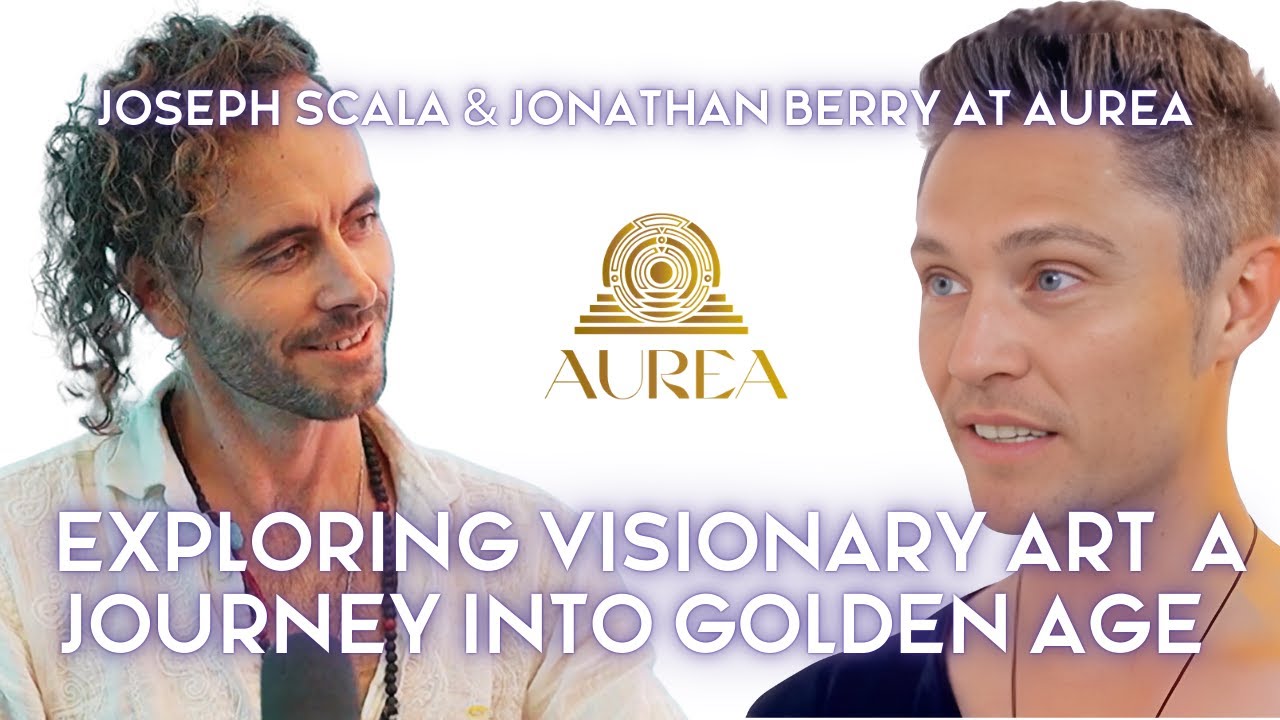
Standing in front of a Joseph Scala painting does something physical. His interviewer at AUREA II described looking at the work and feeling as though he had taken a psychedelic without taking one, caught between the sensuality of the figures and the charged energy moving around them.
Scala is a classically trained artist working in the visionary and mystic tradition, and this was a short conversation on the AUREA II floor with artist and interviewer Jonathan Barry. The event's theme was the Golden Age, which made Scala an apt guest: he paints the future by encoding the ancient past.
Why Joseph Scala encodes ancient civilizations into his paintings
Scala said he did not transition into visionary art from somewhere else. He started there, and the work has kept evolving steadily across the past decade or so.
The fascination goes back further than the career. He traces it to being a toddler drawn to Native American cultures, and to a question he could not put down about the gap between modern civilization and tribal culture. That question now runs through the paintings, which he encodes with messages from ancient civilizations.
His view of the historical record is skeptical, and he stated it as his own reading rather than settled fact. "Our past as we know it, as we're taught in school, is mostly wrong," he said, calling it a set of assumptions. His argument is that very few people actually know what happened, and that a great deal of ancient knowledge has been kept out of mainstream reach. His conclusion is where the Golden Age theme comes in: understanding our future depends on understanding our past, and if people genuinely woke up to how ancient humanity is, he believes it would change everything.
How he knows when a painting is finished
Scala does not decide a piece is done by looking at it. He decides by feeling it. The cue for finishing a work, and for where to place an element in a composition, is a sensation inside his own body.
He calls it vibration. Color, shape, and texture each provoke emotion, and he uses that response as the instrument. "When I'm painting and I can feel the vibration of the work, just standing in front of it, that's how I know that I'm doing the right thing."
That method explains the effect his interviewer described from the other side of the canvas. The work is built to be felt in the body first, which is why viewers reach for the language of altered states when they try to describe standing in front of it.
What Joseph Scala thinks AI means for artists
Scala's position on AI art is calm and mostly favorable. He called it advantageous to the art community, said the output has advanced quickly, and then named the limit plainly: "it lacks soul at this point in the game."
He named the condition that would change his mind. When there is a sovereign robot being that can sit down and create a piece of art of its own accord, he thinks that is the moment AI takes over the art world. Until then, in his read, artists are fine.
He also named what he thinks AI is actually made of. Looking at compositions he finds genuinely beautiful, his response is that they rest on hundreds of years of human beings evolving the creative process. That inheritance is what taught the machine what good art looks like in the first place.
His advice to the next generation of creators
Asked for a direct message to creators of every kind, Scala gave one instruction. "Be curious about who you are, and seek that. Find out who you are."
He framed it as the actual assignment of a life: who am I, where am I coming from, what do I have to give the world. Alongside it he named a genuine state of curiosity about the world as the thing worth cultivating.
His observation about most creative careers is that they run heavy on doing and light on introspection. People get caught up in being something and having a certain impact, with very little emphasis on knowing the deeper aspects of who they actually are. For an artist who finds his next brushstroke by feeling for it, that self-knowledge is the tool, not a side project.
Scala's answer to a golden future turns out to be the same as his answer to a finished painting. You feel your way toward it, and you find out who is doing the feeling.
Watch the full talk above.
Frequently asked questions
Who is Joseph Scala?
A classically trained artist working in the contemporary visionary and mystic tradition, interviewed at AUREA II during an event themed on the Golden Age. His paintings combine figurative beauty with charged, energetic fields, and he encodes them with messages from ancient civilizations. His interviewer placed him in the lineage of visionary painters such as Alex Grey and Android Jones, and described his gallery collection as deeply inspiring.
What does Joseph Scala say about ancient civilizations?
He argues that the version of the past taught in school is mostly assumption, that very few people actually know what happened, and that ancient knowledge has been kept out of mainstream reach. He is careful to frame this as his own reading. His conclusion is that understanding the future depends on understanding the past, and that a real reckoning with how ancient humanity is would change everything.
How does Joseph Scala know when a painting is done?
By feeling rather than by looking. He says the cue for finishing a piece, and for placing an element within a composition, is a sensation inside himself, which he calls the vibration of the work. Color, shape, and texture each provoke emotion, and he uses that response as his instrument. When he can feel the vibration standing in front of the canvas, he knows he is doing the right thing.
What is his view on AI art?
Broadly favorable. He called AI advantageous to the art community and acknowledged how far the output has advanced, while saying it lacks soul at this point. He thinks AI takes over the art world only when a sovereign robot being can sit down and create art of its own accord. He also points out that AI rests on hundreds of years of humans evolving the creative process.
What advice does he give to young artists?
Be curious about who you are, and go find out. Scala frames self-knowledge as the assignment rather than a side project: who am I, where am I coming from, what do I have to give the world. His observation is that creative careers run heavy on doing and being seen, and light on introspection, when the deeper knowledge of yourself is what the work actually draws from.
Back to Wisdom