
Josh del Sol, Devon and Oto at AUREA: Ancient Wisdom, Scalar Technology and Self-Worth
Hosted by Sol of the Embody docuseries at AUREA I, Take Back Your Power filmmaker Josh del Sol, breathwork teacher Devon and crypto mentor Oto trade notes on scalar technology and photographs, whether blockchain is a control grid or a way out of one, and the 5-2-8 breathing pattern Devon led the room through live.
Devon told the AUREA I room that for two years he has been collecting photographs. People send him pictures of themselves, he lays a geometric blueprint over the image and sets it on what he calls a scalar plate. Then he started doing it with farms, for free, and says the farmers reported more birds in the fields, more abundant plants and better soil.
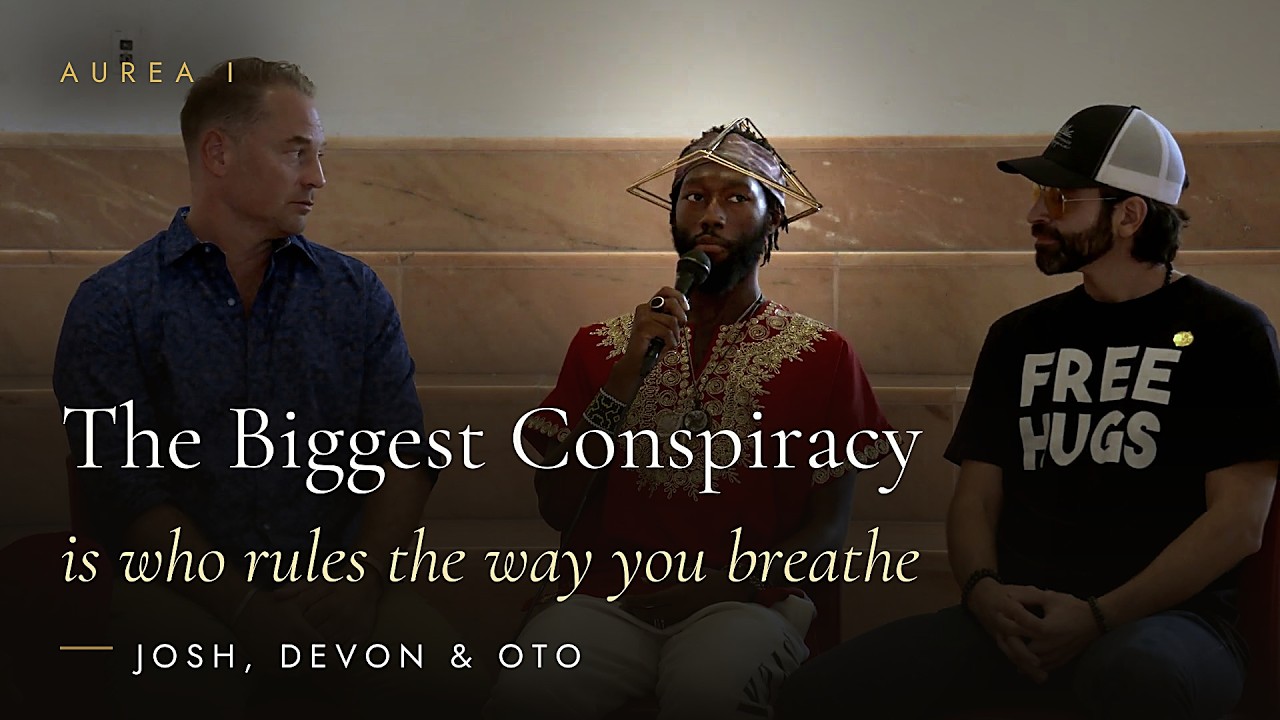
The conversation was hosted by Sol of the Embody docuseries, who put three people on one couch without a shared subject and asked them to find it live. Josh del Sol came from EMF and technology safety and now works on consciousness. Devon, who goes by the Black Airbender, teaches alchemy breathwork and works with scalar technology. Oto is a blockchain and crypto mentor who also coaches on abundance. What they landed on was the responsible use of technology, ancient or otherwise, and where a person's sense of worth is stored.
What Devon means by scalar technology
Asked to define it plainly, Devon described scalar as two identical frequencies meeting and cancelling each other out, which he treats as a state of harmony rather than a state of nothing. In his framing the phenomenon is everywhere: "your thoughts are scalar, your auric field is scalar, the sun itself is scalar." These are his claims, offered as his own working model rather than as settled physics.
He traces the knowledge to the Dogon and to adinkra symbols, and says researchers who mapped binary code in quantum physics found the closest human parallel in those symbols. His practical method uses photographs. He places what he calls a biogeometric blueprint, which he sources to ancient Egypt, over an image of a person, and puts the composite on a scalar plate that he says emanates more than 40,000 frequencies, so the person receives it wherever they are in the world. When people told him it was placebo, he moved to farms and plants, which he treats as the harder test. His reasoning for why a photo works at all: "when you take a picture of yourself, you're not just taking a picture of what you see." He says the image carries the thought patterns and the auric field, and that this is the energetic fingerprint the transmission follows. He compares the approach to electroculture, the practice of setting copper structures near plants to encourage growth.
What antiquitech is, in Devon's reading
Antiquitech is Devon's term for the idea that old churches were built as healing machines before they were places of worship. His reading of relics is that the preserved bones of saints, encased in gold and glass, were the working part of the device rather than an object of veneration.
He was explicit that this is a theory of his own. His account is that these buildings have a tipping point at the top made of gold or copper, which draws atmospheric energy inward instead of letting it run to ground, and that some of them resemble Nikola Tesla's patents. He points to golden chandeliers hung without light bulbs and to footage of old Chinese temples appearing to light up. In his description a person with an injured right arm would lie at the center of the symmetry while the corresponding bone, held in a conductive case, sat beside them, and their mirror neurons would take the healing pattern from it. None of this is established history, and he presented it as his own dot-connecting rather than as consensus.
Why Josh del Sol brought up Atlantis and the responsible use of technology
Josh del Sol used the panel to say something he had not said publicly before. "I have a past life Atlantean connection and it has to do around responsible use of technology." He connected it directly to his own career: he made the film Take Back Your Power, about smart utility meters and invasive technology, and co-founded the InPower movement.
His interest in ancient technology has a specific shape, and he drew the line himself. The aim is to revive "the heart of what is aligned with natural law that was uncovered in the previous golden age" and carry it forward into the present, rather than to travel backward. The condition he attaches is intention. In a holographic, fractal universe, he argues, technology recovered with the intention to serve the whole behaves differently from technology recovered for advantage, because the person recovering it is also the whole.
Is blockchain a control system or a way out of one?
Oto's answer is that blockchain becomes whichever one you build with it, and that the deciding factor is whether it is used publicly or privately. Josh del Sol put the challenge to him on behalf of Jeff Parker, relaying Parker's line that "slaves have to do with blocks and chains, not free men and sovereign men," alongside the argument that ancient prophetic writing describes technology used for total control of the masses.
Oto did not defend the technology's origins. Asked whether the people who released it may have been the same interests everyone in the room distrusts, he said it probably is, and that this changes nothing about what the tool can do in different hands. His structural claim is that anything introduced into the public sector will eventually fall to the scrutiny and the incentives of centralized government, so real decentralization begins locally and privately, and only becomes public once enough people are already doing it. He extends the same logic to marketing: good projects stay quiet while the copied versions get the budget, so he argues the conscious side has to get better at making worthwhile work visible.
He also gave his read on why any of this matters, and it was about origination. In his view the forces he calls low-vibrational entities cannot create anything, so they take what humans build and distort it enough to sell back. "History doesn't repeat itself, it rhymes, because they can't repeat. If you repeat, then it's obvious." His conclusion is that a technology left alone will be occupied by whoever shows up for it.
Why the panel traces the money problem back to self-worth
Oto coaches on abundance rather than on trading, and the reason is that he keeps finding the same root. "We all give value to these external things in our lives. Society has normalized giving value to external things." When someone brings him scarcity language, his first question is what their relationship with money actually is.
He builds the case from school, where nobody was rewarded for feeling anything and everybody was rewarded for a number, so a higher number came to mean a better person. The emotional attachment survives into adult life and attaches to the car, the clothes and the bank balance. Anything outside you demands more of itself to keep working, which is why the pursuit does not end. His fix is what he calls re-internalizing, and the specific form of it differs per person. What changes afterward is the function of money. It stops being the thing your worth is stored in and becomes the expression of a worth already held, which he describes as feeding a toroidal field: the energy you send toward joy comes back with more capacity to create.
He gave one concrete practice for the most common answer he hears, which is that people want more time. "Do today something that is going to make you more time tomorrow." Take thirty minutes or an hour, build the thing that returns an hour, and repeat it daily until it compounds.
What Josh del Sol does when he feels unworthy
Del Sol's answer was to allow the feeling instead of correcting it. "Could this be okay that I feel unworthy right now," he asked, rather than deciding he needed to change his thoughts so the feeling would stop. He says letting the tension resolve on its own, with a breath, has been a key of the past several months, and he credits his coach Xavier Dagba for putting it in front of him.
He also normalized the feeling for the room, and included himself. His description of the current moment is expansion and contraction in waves, where the insight arrives, the identity does not match it, and the question follows: "am I really worthy, have I done enough work to be worthy of that new reality?" His point was that people experiencing this privately tend to conclude they are broken. "If you feel that, you're not alone. The tribe is experiencing expansion and compression."
The other barrier he named was language. He has been studying Aramaic, and argues that English and its ancestors compartmentalize by default, splitting mind, body and soul into separate objects, while Aramaic carries several layers in a single word. His example is the opening of the Lord's Prayer, where the word rendered in English as "our Father" opens instead toward something closer to "O birther, father-mother of the cosmos." His claim is that some of the walls people run into are built into the words available to them.
What the 5-2-8 breathing pattern is and how Devon teaches it
With five minutes left, Devon led the whole room through a short session of what he calls alchemy breathwork, a practice designed to be done while walking or before bed rather than on a cushion. The pattern is a normal inhale through the nose, then the exhale broken into five parts, at your own pace. Then the same inhale with the exhale broken into two. Then into eight. Then silent breathing through the nose, regular in and regular out.
He noted that the practice is parasympathetic, so it does not carry the risk of passing out that fast breathing methods do. Sol's reaction when it ended was immediate: "Is this the same reality? I feel like I entered a different dimension here."
Devon's reason for building his work around breath is a claim about addiction. He argues people are rarely addicted to the substance or the goal, but to the experience of getting there, and that the experience is carried by a breathing pattern. "The external world will rule the way you breathe until you rule the way you breathe, and that's the biggest conspiracy of them all." He calls the breath a technology in its own right, present in every state including sleep. He attaches the number 528 to DNA and to the chlorophyll in plants, which is his own frequency claim rather than a demonstrated one, and offers an experiment for anyone who wants to test the felt effect: pick a tree and do the pattern next to it every day for thirty days.
The panel had no agreed topic when it started, which Sol pointed to at the end as the whole argument for showing up. "What you came in here for may not be what you leave here with." Three people who work in EMF safety, breathwork and crypto found one subject between them, and it was where a person keeps their worth.
Watch the full talk above.
Frequently asked questions
Who is on this AUREA I panel?
Sol of the Embody docuseries hosts three guests. Josh del Sol, the filmmaker behind Take Back Your Power and co-founder of the InPower movement, who spoke on the AUREA I main stage that same day about ancient wisdom and censorship. Devon, known as the Black Airbender, who teaches alchemy breathwork and works with scalar technology. And Oto, a blockchain and crypto mentor who also coaches people on abundance and self-worth.
What is scalar technology, according to Devon?
Devon describes scalar as two identical frequencies meeting and cancelling out into a state of harmony, and says thoughts, the auric field and the sun all qualify. His method places a geometric blueprint over a photograph of a person, plant or object and sets it on a plate he says emits more than 40,000 frequencies. These are his own claims and his own working model, not established physics.
What is the 5-2-8 breathing pattern?
A short alchemy breathwork sequence Devon led live at AUREA I. Inhale normally through the nose, then release the exhale in five separate parts at your own pace. Repeat with the exhale in two parts, then in eight. Finish with silent nasal breathing, regular in and regular out. He notes it is parasympathetic, so it can be done while walking or before sleep without the risk of fast breathing methods.
Is blockchain a tool of control or of freedom?
Oto argues it depends entirely on whether it is used publicly or privately. He grants that the technology may well have come from the interests people distrust, and says anything introduced into the public sector eventually falls to centralized scrutiny and incentives. His position is that genuine decentralization starts small, local and private, and becomes public only once enough people are already operating that way.
What does the panel say about self-worth and money?
Oto's argument is that school trained people to attach worth to external numbers, and that the habit carries into adulthood as cars, clothes and bank balances. Anything external requires more of itself to keep working, so the pursuit never ends. His practice is re-internalizing, after which money becomes the expression of an existing worth. Josh del Sol adds that feeling unworthy can be allowed rather than corrected.
Back to Wisdom