
Lucas Gerler at AUREA: If the Medicine Isn't Reciprocal, It's Just Extraction
Six car wrecks. Struck by lightning twice. Fifteen minutes clinically dead. He came back and built companies that hand a third of their equity, in perpetuity, to the people the knowledge came from.
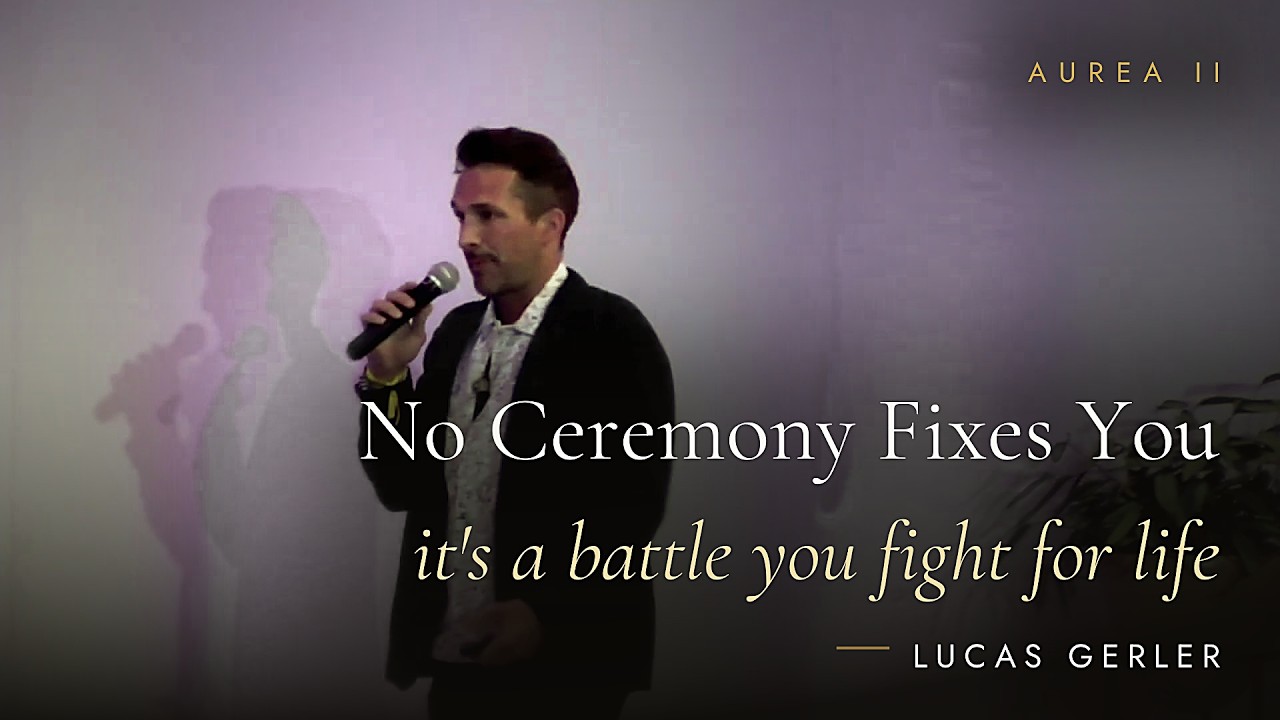
Lucas Gerler had eight minutes, and he opened by listing what he had survived.
Six car wrecks. Struck by lightning, not once, twice. Bumped out of the water by a shark. Fifteen minutes clinically dead, which he describes as having to jump back into his body.
And, said as plainly as the rest: a suicide attempt.
"That was a pretty big one too."
He credits his way back to meditation and to plant medicine work, and he is careful about how much any of it does:
"There's not one psychedelic, there's not one ceremony you can sit in that is going to fix everything. It's a continuous process you go through your entire life."
What almost nobody in the plant medicine world talks about
Most of the conversation around plant medicine is about access: how to get it, where it's legal, what it does.
Lucas spent his time on the opposite question: what goes back?
He pointed the room to something almost none of them had heard of. The Nagoya Protocol is a real international agreement, signed by around 150 countries, governing how the world may use the genetic resources and traditional knowledge of indigenous and local communities, and what those communities are owed in return. It is built on benefit sharing.
The United States has not ratified it.
"When you go to market with drugs, to be ethical, you should follow it."
He is not describing a standard he would like other people to meet. His companies hand 34% of their equity, in perpetuity, to indigenous tribes and environmental nonprofits, routed through an organisation built to move capital directly to those communities.
That is an unusual number, and an unusual structure. Most of this industry's ethics live in a mission statement. His live in a cap table.
Why the money behind plant medicine matters
His case for urgency rests on the money already moving. The illegal trade nets tens of billions a year from the United States alone; the international pharmaceutical market runs to well over a trillion.
Enormous value is being generated from plants and knowledge that came from somewhere, and almost none of it flows back to where it came from. That gap is the whole subject.
How rivers and forests can have legal personhood
The mechanism he is most interested in is one people rarely think of as available.
A corporation is a legal person. It has rights, and it can be defended in court. There is no reason in principle that the same status cannot be extended to a river, a forest or a plant, and several countries have now done exactly that.
"You can protect a river. You can protect a plant. Countries do it. And the more you put this out in the world, the more we can do this together."
It is a striking inversion. The legal fiction invented to let commerce act as a person, turned around and used to give the land standing against it.
What the seven generations principle actually means
The frame he organises his work around is the one worth taking home, and it has nothing to do with any industry.
"You were in your mother's mother's mother's mother's stomach, and experienced all the traumas she had throughout her whole life. So your children's children's children are going to carry whatever you pass down."
It's the seven generations principle, and it makes a demand that quarterly thinking cannot survive. Every decision gets measured against people you will never meet and who will never know your name.
"Everything I do, I do to help as many people as fast as possible, and with the intent to help future generations, and bring back an ancestral earth for them."
He also spoke about the Eagle and the Condor, the prophecy of two ways of knowing, the analytical and the intuitive, separated for centuries and due to fly together again. His reading: most of us are living deep in the eagle's mind, and the work is finding our way back to the condor's.
What Lucas Gerler's talk asks of you
If you are drawn to this territory (and a great many people in AUREA's world are), Lucas is asking a question that the enthusiasm usually skips.
You know what the medicine gave you. Do you know what it cost, who has carried that knowledge for centuries, and whether anything at all has travelled back to them?
A tradition can be honoured or it can be harvested. The difference is not in how reverently you speak about it. It's in the ledger.
Watch the full talk above.
Frequently asked questions
What is the Nagoya Protocol?
A real international agreement, signed by around 150 countries, governing how the world may use the genetic resources and traditional knowledge of indigenous and local communities, and what those communities are owed in return. It's built on benefit sharing. The United States has not ratified it.
What does Lucas Gerler's company actually do differently?
His companies hand 34% of their equity, in perpetuity, to indigenous tribes and environmental nonprofits, routed through an organization built to move capital directly to those communities. Most of the industry's ethics live in a mission statement; his live in a cap table.
What is the seven generations principle?
The idea that every decision gets measured against people you will never meet and who will never know your name; that you carried the traumas of your ancestors, and your descendants will carry whatever you pass down. It makes a demand that quarterly thinking cannot survive.
Can a river or a plant really have legal rights?
In several countries, yes. A corporation is a legal person with rights it can defend in court; there's no principled reason the same status can't extend to a river, a forest, or a plant, and multiple countries have already done exactly that.
Back to Wisdom