
The Resilient Leadership Panel at AUREA: The Difference Between a Community and a Cult
Bitcoin and Web5 developer Polycarp Nakamoto, former Green Beret Matt, and global initiative founder Scarlett close out AUREA III with a panel on decentralized leadership, mesh networks, and the cohesion that decides whether a community survives a disaster.
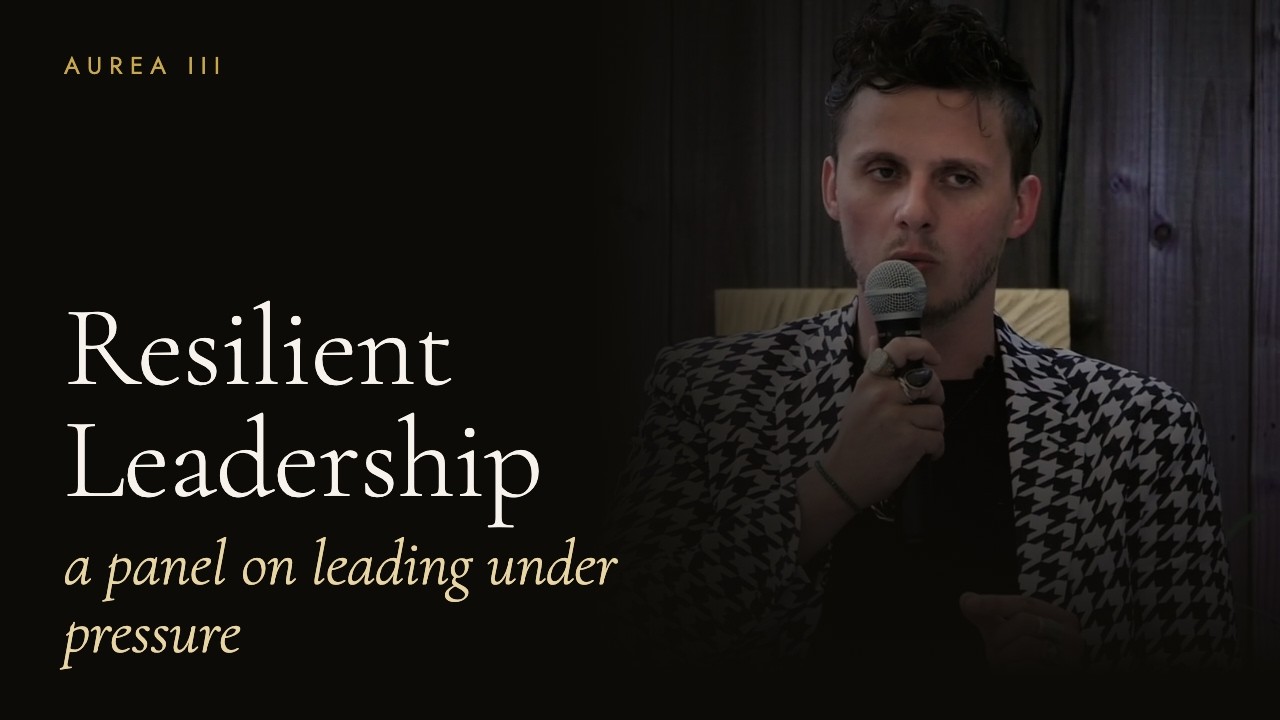
Polycarp Nakamoto took his seat on the AUREA III stage wearing a helmet, and opened by explaining it. "All of you have an identity. The problem is that you don't own that identity. Your identity is an algorithm," he told the room, and on the internet everyone currently uses, somebody else owns every part of that algorithm. Later, asked how this movement of people could become more inclusive, he answered with a sentence nobody in the room expected: "I would like to see more communities and less cults."
This was the Resilient Leadership panel, the last session of the day at AUREA III before the closing. Systems designer Timothy Archer hosted alongside the astrologer Zoe, and the panel was Scarlett, who works in global initiatives and gave the event's keynote on relational intelligence; Matt, a former US Special Forces soldier with eleven years in 10th Special Forces Group as a Green Beret; and Polycarp Nakamoto, a Bitcoin and Web5 developer. The question on the table was what kind of leadership the next era actually needs.

What separates a community from a cult
Polycarp Nakamoto's test is where the power sits. In a cult power is centralized in one person; in a community it is shared, which means the structure survives the loss of any single leader. "In a centralized cult, the leader dies, that's the end. In a community, one of the leaders dies, there's room for another leader or more leaders. There's already leaders that can carry the load."
He offered two more markers, both easy to check from the outside. A cult is easy to join and hard to leave. A community is hard to join and easy to leave, and on the way out "they give you a gift basket." A community celebrates the differences instead. A cult runs on uniformity, which is why you can usually spot one by its look: the same clothes, the same hair, the same tattoos.
His harder point was that most people in the room already run their working lives on the cult pattern without noticing. "Every business has a leader, that's the founder, and he gets all the credit. The CEO goes out and raises all the money." We accept that shape in a company and get nervous when we meet it in a spiritual community, though it is the same shape. His answer to how the movement becomes more inclusive was structural rather than emotional: build decentralized communities and stop operating in the centralized cult method.
Why empowerment outlasts force as a method of leading
Matt learned leadership under conditions that made force useless. Green Berets get dropped into the middle of nowhere with a hundred or two hundred foreign soldiers who do not speak their language, and are expected to train them and possibly take them into battle. "How do I get these people to follow me when they have really no reason?"
What worked was empowering the leaders who were already there, their chiefs and their middle ranks, so that he could fade into the background. He was specific about the mechanism, because he thinks empowerment has gone soft and fluffy as a word. It means talking well about someone behind their back. "How many of you are your partner's greatest cheerleader? You go behind your partner's back and you talk amazing about them." He did the same with eighteen and nineteen year old soldiers, putting them into positions they were not ready for, telling other people they would do great, and watching them stumble, recover, and become prominent leaders a decade later.
Polycarp Nakamoto took the same idea to its endpoint. If you empower everyone around you well enough, you are no longer required for the thing to run. "The real leader can be what I believe all real leaders actually are, which is nameless and faceless." He cited Satoshi Nakamoto, whose identity does not matter because the code is public and the servers are run by the people, and called Bitcoin democracy without a leader. The best compliment he has received came from a guest at one of his large events who asked who was organizing it, and was told by another guest that nobody was quite sure who was calling the shots.
Why the dead internet theory is an argument for putting yourself online
Polycarp Nakamoto's read on the dead internet theory is that it is good news for anyone hesitating to publish. By his account roughly ten percent of people on the internet are actually engaging and creating, and the remainder splits close to evenly between people who only consume and bots.
His conclusion: "If only 10% of the internet is actually creating content, that means there's space for you." He argued that there is no easier place on Earth to step into leadership than online, because the field is far emptier than it looks. "You're competing against the 10% of the users that are actually real."
He was equally clear about what the platforms reward. Bikinis do well. Shock and violence do well. Gardening videos and photography tutorials often do not get the coverage they deserve, because the algorithm hides your nature. His answer to that is more real people publishing, not better tactics.
Why inclusivity that puts anyone anywhere damages an organization
Matt asked permission to be controversial and then made the sharpest argument of the session: real inclusivity means finding a person's actual gift and putting them where it works, rather than seating them wherever they are standing. "You wouldn't take the cook and put them up in the rigging. That person doesn't even know what to do."
His definition of a leader followed from that. Somebody who can see the gift in a person that the person cannot see in themselves, and guide them to the spot where the organization actually needs it. That takes effort and affection. The version of inclusivity floating around most communities, he said, comes from a compassionate place and turns into an excuse. "People use that as an excuse for lazy leadership. They use that as an excuse to say, well, you're standing here, so you get to come and be in this position that you're not qualified for."
He framed leadership itself as one gift among others, no more important than knowing how to cook or run operations or run the sound system, and defined the job narrowly: providing purpose, direction and motivation for the group.

What actually determines whether a community survives a disaster
The answer is how well the people in it know each other. Timothy Archer described a capstone research project at Carnegie Mellon that set out to solve disaster communication for communities in the United States that do not speak English well, and found something else entirely.
What determined whether those communities came through a disaster well had nothing to do with translation services or broadcast. It was cohesion. The team expected a technical fix and the university expected a grant. They studied places across the country, including a city where forty thousand Vietnamese speakers lived with almost no radio in their language. Did the twenty-four year old who speaks Vietnamese and English and lives in the building know the eighty-seven year old woman on the top floor with no relatives nearby, and did he go up and tell her to evacuate. That was the variable.
Matt teaches urban survival courses, and people always ask him for the one item that belongs in a go bag. His answer matches the study. "I can teach you all the Jason Bourne tricks in the world, but the number one thing that I can ever teach you is your community." Breakup, financial crisis or zombie apocalypse, the people around you decide how well you come through it, and he treats choosing them as an intentional practice rather than something that happens to you.
What a mesh network is and why two of these builders want one
A mesh network is a communications network with no central point of failure, built from equipment people own themselves. Matt and Polycarp Nakamoto both work on them, for reasons that turn out to be the same reason.
Matt's case is survival. If your community is your best asset in a crisis, the crisis will often be the moment you cannot reach them, because the power and the cell networks are down. Polycarp explained the difference with the phone in everyone's pocket, which works everywhere without you ever checking which tower it is using, but is permissioned, metered and neither private nor secure. "With the network we have today, Google comes to your neighborhood and they run a bunch of wires, and then they charge you for access. In the mesh network, everyone buys their own equipment, and now they can talk freely with each other, privately, without any third party involved."
The part he cares about is social rather than technical. Building one requires neighbors to communicate and to collaborate on aiming their antennas, which quietly makes people nicer to each other, because nobody wants their signal to drop. He has stopped campaigning for Apple, Google and Microsoft to disappear. "We're feeding them our data voluntarily. We're actually keeping them in power." His example is groceries: a community that buys food in bulk pays what the store pays and keeps the difference. "The solution is each other. Not some new technology. It's not some new app. It's communication, collaboration, and decentralization."
Why the protocols you write should be built to expire
Scarlett's warning to everyone in the room designing new governance was that a rulebook can only ever be correct for a season. "To everything there is a season. And what do the seasons do? They turn, turn, turn."
She has some standing to say it. She opened a mortgage company at twenty-four, consulted for banks and financial institutions, opened stores for large retailers, and has hired more than 1,500 people and fired more than 300. At twenty she ran eight departments at a large East Coast university during a takeover, read the Fish Philosophy book, and started running Friday foghorn breaks to give people back some sense of humanity. She eventually walked away from all of it and went barefoot for a year, because helping people find their light so a company could hit its sales number had started to feel like selling her soul. She now runs the White Lotus Global Initiative, which builds real world prototypes in areas she thinks humanity is badly under practiced at, particularly collaboration.
Her prescription is to identify the essence of what you are creating, invite the protocols that express it right now, and then hold those protocols as living processes so they can evolve as you do. The failure case she named is vivid: build governance so good it lasts three hundred years, and people sitting in a circle like this one in three hundred years will spend their energy figuring out what to do about the systems you left them. "Let us show up with the breathability that the cosmos itself has in its latticing of sacred geometry, which can expand and contract, unfold and fold, without losing, without gain, just holding its integrity." Timothy Archer agreed from the systems side, saying protocols are emergent, and that trying to install a finished one on a group rarely survives contact with the group.
Scarlett also declined the word guide when someone offered it to her after her keynote, on the grounds that the age of the guru is fading out. What she offered instead was the phrase the panel kept coming back to. She calls herself a go firster: someone who makes herself available to cross a threshold first, so that the crossing becomes more available to anyone who wants it, without any instruction to follow her. The session ended with the whole room sitting in silence together for a minute, and then an invitation from the host to treat the evening as practice: be the leader you had just defined, tonight, as your character for the night.
Watch the full talk above.
Frequently asked questions
What is the difference between a community and a cult?
Polycarp Nakamoto's answer at AUREA III was that power in a cult is centralized in one leader, so the group ends when that leader does, while power in a community is shared and other leaders can carry the load. A cult is easy to join and hard to leave; a community is hard to join and easy to leave. Cults reward uniformity, communities celebrate individuality.
What did the Resilient Leadership panel say leadership should look like now?
Empowerment rather than force. Matt, a former Green Beret, described leading foreign soldiers who had no reason to follow him by lifting up the leaders already among them and fading into the background. Polycarp Nakamoto extended it: empower people well enough and you are no longer required, which is why he thinks the most durable leaders end up nameless and faceless.
What is the dead internet theory?
The idea that only a small fraction of internet activity comes from real people creating and engaging, with the rest split between passive consumers and bots. Polycarp Nakamoto puts the creating share at roughly ten percent, and reads that as an opening rather than a loss. If you publish honestly, he argues, you are competing against a far smaller real field than the numbers suggest.
What determines whether a community survives a crisis?
Cohesion. Timothy Archer described a Carnegie Mellon research project on disaster communication for communities in the United States that do not speak English well. Translation services and radio coverage turned out not to be the deciding factor. What mattered was whether people knew each other well enough that a young bilingual neighbor would climb the stairs to tell an elderly woman to evacuate.
What is a mesh network and why does it matter for communities?
A communications network built from equipment people own themselves, with no central point of failure, so it keeps working when the power and cell networks go down. Polycarp Nakamoto and Matt both build them. Beyond resilience, the appeal is social: putting one up requires neighbors to communicate and collaborate on their antennas, which builds the community the network is meant to protect.
Back to Wisdom