
Sayer Ji at AUREA: Your Body Is a Bliss Technology
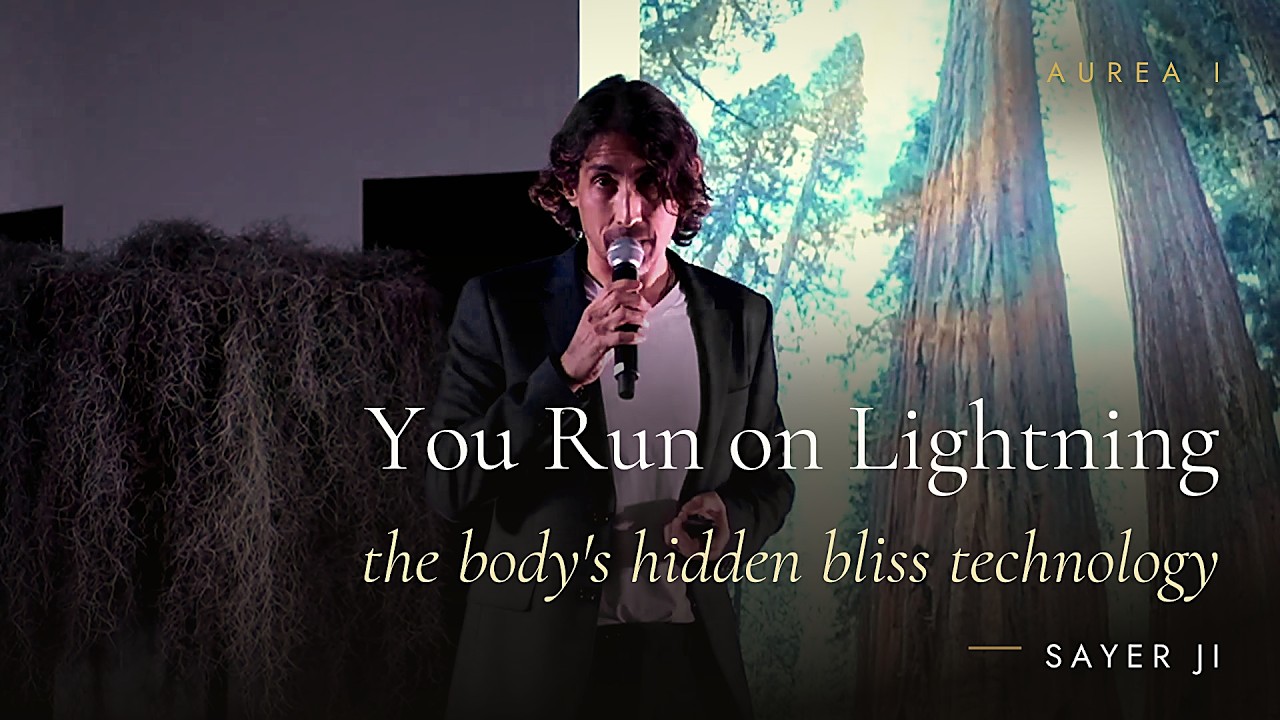
GreenMedInfo founder and Regenerate author Sayer Ji runs the AUREA I stage from a binary star theory of the precession of the equinoxes, through the thousand-ton megaliths at Baalbek, to a pistol shrimp that strikes at the temperature of the sun, all in service of one claim about the human body.
Sayer Ji put a photograph of a pistol shrimp on the screen at AUREA I and told the room what happens when it snaps its claw. The collapsing bubble it makes reaches roughly 5,000 Kelvin, close to the temperature of the surface of the sun. His argument for the next hour was that whatever the shrimp is reaching into, the cells in your body are reaching into as well.
Ji is the founder of GreenMedInfo and the author of Regenerate, a book about the body's capacity to heal itself that he published in spring 2020, when every bookstore on the planet was closed. Jackson Strong introduced him and credited him with recruiting most of the speakers on the AUREA I lineup. The talk ran from binary stars to thousand-ton megaliths to the electrical field across a single mitochondrion, and it ended on the platform he is building. Much of what follows is contested, and he presented it as his own reading rather than settled science.
Where Sayer Ji's work on the body's resilience came from
His starting point was his own childhood. He was a bronchial asthmatic infant, injected with epinephrine, in and out of hospitals, and he came to describe what he went through as medical trauma. The turn came when he concluded that his body could heal itself and that a great deal of what had gone wrong was downstream of choices he could make differently.
He calls that shift radical responsibility for his health, and it produced Regenerate, subtitled around unlocking the body's resilience through what he calls the new biology. The timing was almost comic. The book landed as the world locked down and the shops shut. His summary of that season was a line he clearly enjoys: "they tried to bury us and forgot that we were seeds."
He acknowledged early that his work has been labeled controversial, then declined to spend the talk on the argument. "I'm not here to talk about this because it gets a little bit aggravating," he said, and moved to the material he had come for.
Why Sayer Ji argues our sun is part of a binary star system
His central astronomical claim is that our solar system is gravitationally paired with another star, and that this pairing, rather than the gravitational tug of the sun and moon on Earth's bulge, is what produces the precession of the equinoxes. He credits the researcher Walter Cruttenden and the Binary Research Institute, and the book Lost Star of Myth and Time, with the case, and Dr. Steven Lin, a functional dentist who runs the Human Origin Project, with introducing him to the idea.
The candidate star, in his account, is Sirius. Two bodies in a binary system circle a shared barycenter over long periods, which he puts at roughly 24,000 to 26,000 years, matching the length of the so-called platonic year. His reading is that Sirius is now on the approaching leg of that orbit, and that the approach corresponds to a rise in consciousness. He was explicit about why the astrophysics mattered to him: the claim that we are entering a golden age sounds like nothing at all unless something physical is actually moving.
He pointed to two supports. The Dogon people of Africa, he said, knew that Sirius is a multiple system of three components and claimed descent from it. And the shaft from the Queen's Chamber in the Great Pyramid at Giza still aligns with Sirius, which in his argument is only possible because Sirius, uniquely, does not precess against our sky. He called the whole framework a second Copernican revolution and told the room to go check the research themselves.
What the ancient megaliths tell Sayer Ji about lost technology
Ji has spent several years visiting megalithic sites, and his conclusion is that a civilization with technology we cannot currently reproduce was here before us and was destroyed. He showed the room the Baalbek megalith in Lebanon, which weighs over a thousand tons, and mentioned a nearby stone of around 1,600 tons.
He also showed two sites he found by accident on Kauai: a two-mile run of massive carved stones at the edge of a beach, and a well-known boulder called the grandfather stone. His question about all of them was mechanical. How do you move and miter stone at that scale in an era when the wheel is supposed to be a recent invention?
The frame he puts it in is periodic catastrophe. He pointed to the Younger Dryas, roughly 12,900 years ago, as the last full reset, and recommended Randall Carlson's work and Carlson's podcast Cosmographia for the geology. He also cited Forbidden Archeology, the compilation of anomalous finds by Michael Cremo, and a book called The Reparenting Revolution by a colleague of his who died recently, which argues that repeated cataclysm left the species in a state of reflexive obedience. His most striking line was about how deep that amnesia runs: what is missing, he said, is any sense that anything is missing. On the pyramids he was unequivocal. "There's not an engineer on the planet that could reproduce anything close to what they've built."
What the pistol shrimp has to do with the cells in your body
The pistol shrimp is Ji's model for what he thinks human cells are doing. Its claw strike produces a cavitation bubble that reaches temperatures found at the surface of the sun, which in his reading means the animal is accessing vacuum or zero point energy with a body part, and he believes our own cells access the same reservoir.
He stacked several lines of evidence behind that, all attributed. Louis Kervran's work on biological transmutation, which claims living cells convert one element into another through low energy nuclear reactions, and which he says he summarized across some fifteen researchers in Regenerate. A paper in Nature reporting that the electric field across a mitochondrial membrane is comparable in strength to a lightning bolt. And a 1978 Army study, run to confirm or refute Kervran, which he says found the mitochondrion behaving like a cyclotron, accelerating hydrogen ions to relativistic speeds. His word for it was alchemy: a philosopher's stone inside the body.
He extended the same logic to the water in the room and outside it. He credited Gerald Pollack with the fourth phase of water and the engineer Mark LeClair, formerly of Lockheed, with a claimed fifth phase, a hexagonal crystal, produced during cavitation. In LeClair's experiments, as Ji describes them, a laser and water yield elements across the periodic table in the same ratios found in the Earth's crust, along with more energy out than went in. All of that is disputed work, and he presented it as promising rather than proven.
What Sayer Ji means when he calls the body a bliss technology
"The number one technology is your body," he told the room. "And I believe that your body is a bliss technology." The claim underneath it is biological: he traces every living cell back to a last universal common ancestor roughly 3.4 billion years old, which makes life, in his phrase, immortal by descent.
The thread of immortality runs through the germline, he said, while somatic cells die so new generations can be born, and some animals such as hydra sidestep the trade entirely. He reads cancer as a regenerative response gone wrong, a cell that immortalizes itself and kills the body doing it, which for him is evidence of how much repair capacity is sitting there unused. He mentioned the raw meristematic cells at the crown of a Romanesco cauliflower as an example of eating that capacity directly.
He also gave the practical version. He said the way a person arrives in the world, water birth for instance, shapes how easily they recognize their own nature, and that the modalities for getting back to it now number in the infinite. His own guardrail was a warning about living in his head. When he goes into his mind and starts trying to solve the theory of everything, he said, he gets struck by a cosmic two by four and reminded of how small he is. "It's the heart that can truly comprehend the universe."
Why Sayer Ji says the limit on new energy technology is a spiritual one
Ji's position is that the technology to re-substrate the planet's energy and materials already exists, and that the bottleneck sits in the people who would hold it. He put it as a rule: until there is a matching moral and spiritual evolution, this class of technology gets suppressed, misused, or turned into another disaster.
His examples of the stakes were specific. Water cavitation, in the research he cites, can produce transuranic elements from a few hundred dollars of hardware, which is the same chemistry that sits behind nuclear weapons. He mentioned the Atlantis myth, in which a previous civilization undoes itself by misusing what it built, and treated it as a description of a recurring position rather than a story about a lost island. He also raised Stanley Meyer's water fuel cell, and said Meyer was assassinated for it, a claim that has never been established.
His measure of the same asymmetry was the live stream running behind him. "You had to be a yogi master and prove yourself over a thousand lifetimes before you were given the opportunity to connect to everyone in the way we are doing now," he said. "Now, any schmuck like myself can get on and project themselves all over the world." Power arriving that fast, in his framing, arrives with a proportional responsibility.
What Unite is and why Sayer Ji built it
Unite is the platform Ji and his team have spent more than a year and a half building, and his stated purpose for it is to take the big brother out of big tech. It is a full stack meant to keep creators from having their information harvested, monetized, and used against them.
He was candid about what it is and is not. He called it web 2.5, a transition step that still requires some trusted centralization, and named permissionless, trustless decentralized systems as the actual destination. He also named the constraint that no code solves: a platform only works if the community on it shares values and lives in integrity.
What he wants it to carry is beauty, inspiration, connection and truthful reporting, some of it controversial by design, so that a diversity of perspective has somewhere to live while the older structures come apart. He borrowed a phrase from Charles Eisenstein for the goal, the more beautiful world our hearts know is possible, and said the platform is his contribution toward it. He closed by promising to be out there using it himself, sharing what he can and living the best life he can manage.
Watch the full talk above and learn more about Sayer Ji's work.
Frequently asked questions
Who is Sayer Ji?
The founder of GreenMedInfo, a database of research on natural medicine, and the author of Regenerate, published in spring 2020 as the world locked down. His work argues that the human body has far more capacity to heal itself than conventional medicine credits. He speaks about that, about ancient civilizations, and about the platform Unite, which he and his team have been building.
What is the binary star theory Sayer Ji described at AUREA I?
The proposal that our sun is gravitationally paired with another star, likely Sirius, and that this pairing rather than local gravitational effects explains the precession of the equinoxes over roughly 24,000 to 26,000 years. He credits Walter Cruttenden's Binary Research Institute and the book Lost Star of Myth and Time. It is a minority position that mainstream astronomy does not accept.
What does Sayer Ji mean by calling the body a bliss technology?
That the body is the most advanced instrument a person will ever operate. He traces all living cells to a common ancestor roughly 3.4 billion years old, argues that a thread of biological immortality runs through every one of us, and points to mitochondria and cellular water as evidence that the body taps energy sources physics has barely mapped. His conclusion is that our default state is love rather than fear.
Why does Sayer Ji talk about the pistol shrimp?
Because its claw strike creates a cavitation bubble that reaches around 5,000 Kelvin, roughly the temperature of the sun's surface. He reads that as a small animal accessing zero point energy, and treats it as the model for what human cells may be doing. Cold fusion startups, he said, are using the same shrimp as a design template for their systems.
What is Unite?
A media and creator platform Ji and his team built over more than a year and a half, designed so that users are not harvested for data. He calls it web 2.5: a transition that still requires some trusted centralization, with fully decentralized systems as the goal. He wants it to carry beauty, inspiration and reporting that centralized platforms remove, and says it only works if its community lives in integrity.
Back to Wisdom