
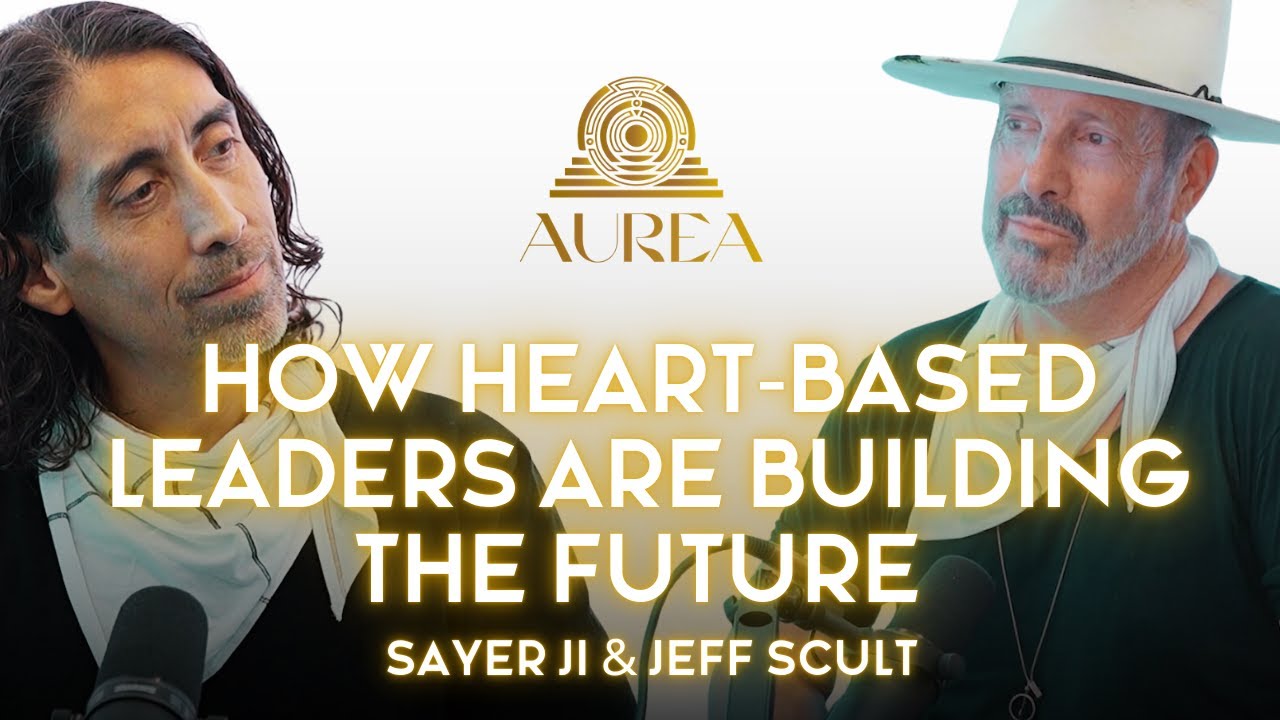
Sayer Ji and Jeff Scult at AUREA: Seek the Like-Hearted
Jeff Scult, founder of One Golden Thread, and Sayer Ji, founder of GreenMedInfo, spoke at AUREA II in Miami about the question in Zion National Park that ended Scult's habit of hiding behind words, the 33 words that started One Golden Thread, and Ji's contested case against what he calls medical monotheism.
On the seventh day of a seven-day iboga, ayahuasca and San Pedro journey in Zion National Park, a facilitator sat down with Jeff Scult, asked him a question, and listened to him slide around it the way he had slid around every question for years. Then the man looked at him and said: "Are you exhausted of being this version of yourself? Because I can tell you it looks exhausting, and I can tell you it's tiring for the rest of us." Scult's account of that moment is precise. "It landed like an anvil drop on my soul."
He founded One Golden Thread, the apparel company built around the idea that every person carries a golden voice. Sitting beside him was Sayer Ji, founder of GreenMedInfo. The two had just come off the heart-based new paradigm panel at AUREA II's Golden Future event in Miami, and Soul Ballard interviewed them together afterward. What followed ranged across ego, self-love, plant medicine, manifestation, and where authority over your own body sits. Ji's positions on medicine and public health are contested and are given here as his own.
What Jeff Scult means by "seek not the like-minded, seek the like-hearted"
He means look for people whose hearts point where yours points and whose minds do not. "Seek not the like-minded. Seek instead the like-hearted, whose unique perspective opens and blows your mind every time."
He drew it straight from the panel he had just left. Four people arrived at the same premise from four radically different places, and the value was in the distance between them. "So it wasn't like we're just agreeing with each other and finishing each other's sentences. We're bringing our own language that speaks the same from the heart." Ji made the same observation from his own field, calling out the pull toward a single narrative that would rule them all, and arguing for many approaches to any problem instead of one.
Scult pushed the point further when the conversation turned to oneness, a word he thinks gets used too loosely. His alternative was every one by oneness: each person showing up whole and sovereign, one after another, until solidarity is made of complete people. "We all have a golden voice." He included his own decades of not using his. "This is somebody who suppressed his for half a century."
What happened on the seventh day of Jeff Scult's plant medicine journey in Zion
A facilitator named the exact thing he was doing with language, which was hiding inside it. Scult described himself as so clever with words that he could deflect any real question about himself, turn it back on the asker, and never answer. The facilitator's question about whether he was exhausted by that version of himself ended the strategy.
What came out the other side was written down. He wrote a letter to himself he calls his Life 2.0 letter, and then he buried it. In 2014 he was too afraid to show anyone. In 2015 a woman going through a dark night of the soul said something that echoed one of its stanzas, and he offered it to her. "My heart is beating, I'm sharing like the rawest version of myself with the obliteration of all the lies around ego and fear and pain and love and all of it." She went quiet. He drew a breath to apologize for going too deep. She thanked him instead, said she felt lighter, and told him to share it.
He changed the subject. A month later, he could no longer unsee it.
The 33 words that started One Golden Thread
A stranger at a gathering in New York asked Scult what he planned to do with the manifesto he had just shared. He said nothing, and added the standard question. "Who am I to share?" The man answered in 33 words, poked him in the chest with three fingers, and changed the direction of his life.
The words, as Scult recounts them: we are on this planet for three reasons, to learn, to love, and to share, and if you are not sharing your gifts, you are being selfish. He calls that the obliteration of the lie he had been living inside, the one that says putting your gift into the world is egoic or narcissistic. "You're inspiring me to share mine."
That is what became One Golden Thread: tying golden threads on people's wrists and performing the manifesto as a spoken word piece. He drew a line under how it began. "I never started anything with values and intent. I started everything before this with an agenda, to create this kind of a clothing company, to build a better mousetrap. But this was just pure intent, and it continues as such."
What Sayer Ji means by "medical monotheism"
It is his term for the belief that there is only one legitimate way to treat a given condition. In his framing, that single approach is symptom suppression using patented chemicals, and his objection is to the monopoly rather than to any individual treatment. He also questions pandemic-era public health measures, which he raised in the same breath. These are his positions and they sit outside mainstream medical consensus.
What he was arguing for is the same thing Scult was arguing for from a different direction: diversity as a survival trait rather than a courtesy. He reached for flowering plants as his image, the wild profusion of angiosperms that produces most of what humans eat, and said the same principle applies to people. "There's something about that diversity in our hearts too, and everyone has a unique gift."
He offered one more piece of etymology that the room liked. The word alone, broken open, reads as all one. Solitude connects you to the mystery, in his account, while carrying its own paradox, since a person can also be convinced they are walking an isolated path toward the abyss. He credited Heidegger for that second half.
Why Sayer Ji says the heart can hold what the mind cannot
His claim is that the mind is structurally unable to comprehend infinity and the heart is built for it. "The mind could never comprehend the infinite. In fact it's abysmal and almost terrifying. But the heart is designed to comprehend the entire mystery of the infinite creation."
He arrived at it through his father, who has spent his life trying to work out a theory of everything and who was, by Ji's account, not always emotionally present as a result. Ji inherited the same obsession with understanding things. The shift he described in his father is the one he was pointing at: a man who began with the idea that the universe is self-knowing and has come around to the idea that it is self-loving.
Scult heard the same thing in the way Ji was speaking, and named it back to him: a man who is in harmony because he remembers to feel while he is thinking. "The heart sees before our mind, even though we forget that."
Why both men name self-love as the first step toward everything else
Ji was blunt that the absence of it breaks everything downstream. "Without it, it doesn't really work. Relationships don't work. I didn't have it. I had a couple marriages that didn't work out because I hadn't learned how to love myself." He met his partner after reaching that point, and only because she had walked the same road.
His picture of what two whole people make is geometric. Where erotic dynamics often run on two people trying to fill a hole in each other, which he considers unsustainable, two complete people produce a mandorla, the vesica piscis where the circles overlap. Scale that across a community and the pattern becomes a flower of life. "That's how I feel that we will bring the new golden future in, but it does start with self-love being the first real step."
Scult's version was shorter. "If you want an infinite world, or you want a unitive community, it begins within. Nobody gets left behind, because we always remember we're all golden inside." He added the structural version of the same idea a moment later. "We're all here to create containers for things to thrive. We're all creating our own container, and then those containers become concentric circles, and that's a collective consciousness."
What Jeff Scult means by a "benevolent bridge"
He means Setu, the Sanskrit word he encountered last year and now calls the most powerful word in his consciousness. He glosses it as a benevolent bridge, and he uses it to describe what a gathering like AUREA actually builds.
His image for the whole thing is mycelial. Underneath the event is a network of bridges, and people step onto them by choice. "Nobody gets pulled onto the bridge. Nobody gets pushed onto the bridge. We all get to step and flow, very Bruce Lee like." The function of a room like that, for someone deep in their own work, is a zoom out. "This allows us to get out of the lane that we're rolling in, and to see the tapestry."
The last thing he named was a posture change he had to make in himself. He can fall into being what he calls a problemist, fighting against something, and he prefers being a solutionist, providing the container for what is already alive to flow. "We're not fighting against the matrix. We're simply building a pivot party, and it's a pivot party for all who want to answer the call."
Ji closed on the room itself, and on Miami. He believes something has shifted in the energy of that place, a claim he ties to ley lines and meridian points and offers as his own reading. What he was sure of was simpler: people from unrelated walks of life meeting at the same level and building solutions together. Scult had already given the practical version of it a few minutes earlier, when he cut off his own theorizing. He described years spent heady about all the things there were to teach and preach and learn for, and the correction that arrived recently as a phrase: the deliciousness of consciousness. "Let's just come back to connection and love, and how do we allow people to embody it." Or, more bluntly, "Less talk, more action, and more joy."
Watch the full talk above and learn more about Jeff Scult's work and Sayer Ji's work.
Frequently asked questions
Who are Sayer Ji and Jeff Scult?
Sayer Ji is the founder of GreenMedInfo and works in the health space, where his views on conventional medicine are contested and sit outside mainstream consensus. Jeff Scult is the founder of One Golden Thread, an apparel company built on the idea that every person carries a golden voice. Both spoke on the heart-based new paradigm panel at AUREA II's Golden Future event in Miami and were interviewed together afterward.
What does "seek not the like-minded, seek the like-hearted" mean?
It is Jeff Scult's formulation for choosing company by alignment of heart rather than agreement of opinion. He drew it from the AUREA II panel, where four speakers reached the same premise from four unrelated starting points. His argument is that people who share your direction while bringing different language and different modalities will keep opening your mind, where people who simply agree with you will not.
What is "medical monotheism"?
Sayer Ji's term for the belief that only one approach is legitimate for treating a given condition. He characterizes that approach as symptom suppression using patented chemicals, and argues that complex problems need many methods rather than one sanctioned method. He also questions pandemic-era public health measures. These are his positions, stated on the AUREA stage, and they are contested by mainstream medicine.
How did One Golden Thread start?
With a letter Jeff Scult wrote to himself and buried in 2014, too afraid to share it. He read it to one woman in 2015, then to a stranger at a gathering in New York who asked what he intended to do with it. That man's answer, 33 words about learning, loving and sharing, sent him into tying golden threads on people's wrists and performing the piece as spoken word.
What does the Sanskrit word Setu mean?
Jeff Scult glosses it as a benevolent bridge, and calls it the most powerful word in his consciousness. He uses it to describe what conscious gatherings build: a mycelial network of bridges people step onto by choice. His emphasis is on the absence of force. Nobody is pulled onto the bridge and nobody is pushed; everyone steps and flows, which he compared to Bruce Lee.
Back to Wisdom