
Shay Rowbottom at AUREA: The Post She Was Most Afraid to Publish
LinkedIn video strategist Shay Rowbottom on the AUREA I stage: the prayer in her diary, the depression post that brought in leads, and why shame is what keeps a business small.
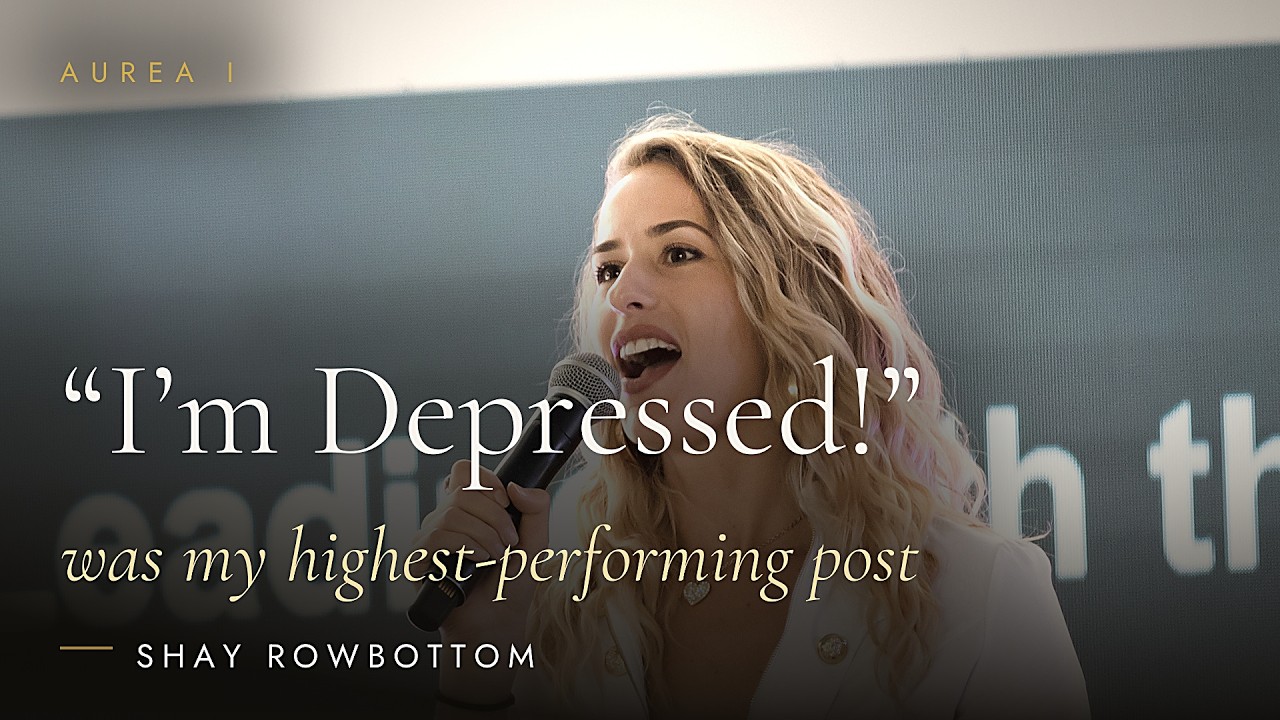
Shay Rowbottom walked onto the AUREA I stage with a question for the room: who would like to make more money? Then she told them the post that made hers was the one she was most ashamed to publish.
She has grown close to a million followers and built a seven-figure business teaching founders to sell through video on LinkedIn. The talk was half tactics and half the thing underneath the tactics.
What happened when she posted about her depression
She posted a video that opened with the line "I'm depressed, and I don't know what to do," and it became her highest-performing video to that point. It also brought in business. "I literally got business on a post where I was saying I was depressed," she told the room. One woman commented: "This is so authentic. These are exactly the type of professionals I want to work with."
The context matters. At 25 she was running a digital marketing company she had come to resent, with investors she fought and partners who did not respect her. She was clear about her own part in it: "we tend to attract whatever energy we ourselves are radiating out." One night she wrote a prayer in her diary asking for a sign her life would have purpose. A week later a man at a networking event told her to get on LinkedIn, where video had just launched and almost nobody was using it. Her first video was thirty seconds, no makeup, filmed on a phone.
Three videos a week for two months generated over $100,000 for the business. She sold her shares, moved to Miami, and rebuilt around LinkedIn. That company has since done close to $4 million.
What to post on social media if you want it to bring in clients
She gave the room one question to frame every piece of content: "What do I know that my target market doesn't know that would make their lives easier?" Answer that consistently and you become the person they call when they finally need the thing you do.
It is a deliberately low bar, and that is the point. It does not require a studio, a strategy deck, or a personal brand. It requires you to say out loud what you already know, to the specific people who do not know it yet.
Why leading with the problem outperforms describing your service
Naming your client's problem before you name your solution gets them in the door, because they recognize themselves before they have to evaluate you. She modeled it live: "so many people today struggle with growth on social media. They post all the time, but never seem to get reach." Hands went up across the room.
She pulled a volunteer up to try it. Mio pitched her business this way: "You know how women experience exhaustion and burnout when they just give give give to everyone else and don't give to themselves?" The room reacted before she had said a single word about what she sells. Shay's note afterward was that this works in conversation too, not only in posts. When someone at an event asks what you do, answer with the problem.
Why personal posts bring in more business than business-only content
People do business with people, so posts that have nothing to do with your service often convert better than the ones that do. She calls it casting the net wide: a family trip, a divorce, a job you got fired from, an illness, a retreat you went on.
Her argument is that industry content alone rarely closes anyone. What closes them is the recognition. "I saw your post about growing up with narcissistic parents, and that really resonated. I grew up in a house like that, too. I want to work with you." The second benefit is the one founders underrate: you attract clients you do not have to wear a mask around. She was blunt about the cost of the alternative. A lot of people burnt out in business blame the work, when what exhausts them is the mask they put on to do it.
Why video converts better than photos or text posts
Her videos on LinkedIn are not her highest-viewed posts; they are her highest-converting. Photos and text often win on reach and engagement, and still sell less, because video is where a stranger decides they know you.
She also named the part nobody advertises. Video removes every place to hide. "That's you. That's your voice. That's your face." Clients tell her they do not like how they look and sound on video, and her answer is that this is how they look and sound in every meeting they have ever taken. She came to treat it as a spiritual practice rather than a production task.
Why shame is the real thing keeping your business small
Asked what stops people from posting, she skipped past the usual answers and named shame. Shame is hiding, and a business built by someone in hiding stays the size of the hiding place.
She walked the room through David Hawkins' Map of Consciousness, a scale of human emotional states with shame at the bottom and enlightenment at the top. Her focus was the line in the middle, where pride sits just below and courage just above. "When you fall victim to pride, you're very likely to get sucked downward. And when you open yourself up to be courageous, you are also a vacuum for going the opposite direction." Posting the thing you are afraid to post is how you cross that line.
She traced her own shame to a childhood where being authentic was not safe. Her read is that children who are not met will trade their real selves for belonging, and then carry the trade into adulthood, where it quietly selects their business partners for them. She attracted partners who shut her down the same way she had been shut down.
Is being yourself actually a marketing strategy?
Her closing claim was that being yourself is the best marketing strategy, and her evidence was not inspirational. It was structural: businesses built on a persona eventually get burned down by the person maintaining it.
She has watched large followings, big blogs, and real empires collapse, and her diagnosis is the same each time. "It doesn't matter how much money you make, how many followers you gain, and how viral your posts are going if you're building on something that is not 100% authentically you, you will eventually want to burn it to the ground."
She left the room with an assignment rather than a summary: step into courage, shoot the first video, and see what comes back. Jackson Strong put the same point in AUREA's language from the stage afterward. If you do not feel worthy of being yourself, expressing yourself to the world will stay hard. The inner work comes first.
Watch the full talk above and learn more about Shay Rowbottom's work.
Frequently asked questions
What was Shay Rowbottom's depression post?
A LinkedIn video that opened with "I'm depressed, and I don't know what to do." She made it as a genuine cry for help, not a strategy. It became her highest-performing video at the time, drew messages from people who had been afraid to talk about their own depression, and brought in business leads from viewers who read it as a signal of who she actually was.
How did she make $100,000 from LinkedIn?
She posted three selfie-style videos a week for two months, with no production budget, while running a video marketing company. That consistency generated over $100,000 in business. She then sold her shares in that company, moved to Miami, and rebuilt around teaching LinkedIn video, a business that has since generated close to $4 million.
What should I post about on social media for my business?
Her single framing question is: what do I know that my target market doesn't know that would make their lives easier? Answer that consistently and you become the obvious person to call when they need your service. She pairs it with leading with the client's problem rather than describing your offer, because people recognize themselves in a problem before they can evaluate a solution.
Why does she recommend video over photo and text posts?
Video converts better even when it gets less reach. Her LinkedIn videos are not her highest-viewed posts, but they are her highest-converting, because people feel they know you after watching you speak. She also treats it as inner work: video leaves nowhere to hide from your own face and voice, which is exactly why most people avoid it.
What does shame have to do with marketing?
Shame is hiding, and hiding caps what a business can become. Using David Hawkins' Map of Consciousness, she pointed to the line between pride and courage: pride pulls you down the scale, courage pulls you up. Publishing the thing you are afraid to publish is how you cross it, and she argues that is also the post most likely to work.
Back to Wisdom