
The Spirituality Panel at AUREA: What Spirituality Is, and Why Now
Four teachers take the AUREA I stage for a panel on what spirituality actually is, as pranic healing instructor Agustina opens the room with a Meditation on Twin Hearts, Bolivian curandera Lila Lotus sends her students back to their own ancestors, and Alfacast host Mike Winner makes the case for open source spirituality.
Before a single question was asked, the spirituality panel at AUREA I had the whole room sitting with palms turned outward at chest height, holding the planet in front of them like a small ball, blessing it, and then chanting om into it three times.
Four teachers took that stage: Agustina, a pranic healing instructor with the Institute of Inner Studies and the spa director of Tierra Santa Healing House at the Faena, who helped make the room itself available; Natalia, a facilitator of psychedelic breathwork who runs retreats for leaders after a career in a tech startup; Lila Lotus, a curandera from Bolivia who leads San Pedro journeys and trains healers; and Mike Winner, co-owner of Alfa Vedic and host of the podcast Alfacast. The moderator opened with the plainest question available: what is spirituality, and why is it central right now?
What the AUREA I panel said spirituality actually is
None of the four defined it as a belief. Every one of them defined it as a way of living that shows up in ordinary conduct.
Agustina went first. "It is a state of existence. It's a way of living life. It's a way of being connected," she said. "Spirituality for me is being humble, loving and kind with every sentient being." Mike Winner reached for a different word: remembrance. "It means remembering who I am, who we are, and our connection to the divine, and how we can serve it, serve ourselves, and serve each other every minute of our days."
Lila Lotus put it in the body of a family line rather than in a doctrine. Her answer to what spirituality is came out as an instruction about where to look for it, and she pointed backward, to ancestors, language, food and song.
Why the panelists describe this moment as a golden age already underway
All four treated the golden age as a present condition rather than a scheduled arrival. Their disagreement was only about what makes it visible.
For Agustina it is an era in which humanity wakes up to being one, and judgment dissolves on its own. "When you really understand a person, there is not even need of forgiveness because there's nothing to forgive," she said. "You're just understanding that that person is in their own path, in their own evolution."
Mike Winner looked out the window of the room and said he could see it there. "The golden age for me is here. It's in all of us, and it's how we interplay with it to make it more apparent. And as it becomes more apparent, then others will see it as well." Natalia framed it as a change in perception rather than a change of address: the earth currently running on a linear frequency of yes or no, all or nothing, past or future, and the golden age as a unified field where opposites are both allowed. Lila Lotus took the longest view. She described children who will one day hold ceremonies naming this generation as the ancestors who cleared the path.
Why Lila Lotus tells her students to start with their own ancestors
Lila Lotus, a curandera raised in Bolivia, teaches that the fastest spiritual path available to a person is the one their own bloodline already walked. She calls it an elevator for the soul.
Her instruction to students is concrete: find out what songs your people sang, what rituals they kept, what food they ate, and follow that. "The country that you were born has been chosen by you before coming here," she told the room. "You are the dream of them. So, don't ignore that dream because you're ignoring your own prayer."
She came to it the long way. She began her own path with Yogananda and the Hindu tradition and stayed there for years, until a grandmother came to her in a dream and told her she had forgotten her own mountains. After twenty years away she went back to Bolivia, a country she notes has some thirty-six languages, and slept in the mountains with indigenous people to find out who she was. She was careful not to turn it into a prohibition. Go with a Hindu teacher or a Buddhist one if that is the call. The nearer call, in her reading, is the one already standing in front of you: your mother, your father, your grandparents, your genealogical tree.
What pranic healing is, and why Agustina says awareness has to come first
Pranic healing is a hands-off energy technique built on prana, the life force carried in breath, and Agustina teaches it through the Institute of Inner Studies in the Philippines, founded on the work of Master Choa Kok Sui. She was precise that it complements a person's own healing rather than replacing it.
The method, in her description, runs in steps. The practitioner scans the energy body of the patient, which she compared to sensing rather than seeing. Cords connecting that person to others are cut. Each chakra is assessed as congested or depleted. Stagnant energy is removed, and fresh energy of the specific type needed is put back. She said it can be applied to physical complaints and equally to phobias, trauma and addiction, and that crystals speed the process for her while teachers of higher attainment do it with intention alone.
Her own path into it started early. Her grandparents taught her yoga and pranayama as a child; by twelve she was working with energies, and in her twenties she got frightened, because things were happening and she had no school and no teacher to show her how to purify. That gap is why she is insistent on the first step. "Without awareness, there is no transformation," she said. Find the root of the disorder before you go looking for a healer, and do not hand the process to someone else.
Why Natalia stopped running her life on masculine energy
Natalia burned out running a tech startup, and her recovery reorganized how she works. She now describes the sequence as feminine energy giving birth to the idea and masculine energy manifesting it, in that order.
She was blunt about the cost of getting it backward. Technology is a masculine industry, she said, so she spent her days in go, go, do, do, and then she broke. Shadow work, inner child work, meditation and breathing were what brought her back into balance, and she says she is still a strong woman on the other side of it. Her image for the change is a pun she has clearly earned: she stopped being a bomb and became a balm, high potency and strong, and also nourishing.
The moment it landed was at a retreat, when a woman told her that her energy was like perfume, something she wanted to stand near and inhale. Natalia's read on that is that feminine energy is the strongest force in the room rather than the softest one, because it is what gives birth to life and to ideas. She left the audience with the assignment in that form: be a perfume, and make every place you walk into smell better.
What Mike Winner means by open source spirituality
Mike Winner told the panel he had received the phrase that morning: open source spirituality. His claim is that connectivity has given this generation the ability to study every tradition at once and assemble a practice from what genuinely resonates, which was very difficult even twenty years ago.
He described his own morning as exactly that kind of assembly: Kundalini yoga, qigong, traditional meditation, and inner alchemy from the Western tradition, moved through in his own flow. He hosts the podcast Alfacast, where he interviews physicists, permaculturists and researchers, and he treats that stream of access as the raw material.
He then named the two things access cannot supply. The first is mentorship. "Not saying that the guru has to go away because I do believe we need mentorship. It's extremely important. And actually more important than ever, we need that elder to help us be directed because we can get lost in the sea of all this information." The second is rites of passage, which he says we have lost. His third safeguard is community, which is what he and his partners are building at Alfa Vedic: people who respect each other's independent path and still stay open to reflection and criticism. He also spoke for staying rooted in one place. He is raising his children in California, in the far northwestern corner of the state, because it is his motherland.
What the panel said about the divine masculine
Every panelist argued that the rising divine feminine requires an equally attended divine masculine, and two of them were sharp about the version of feminine spirituality that treats men as the problem. Natalia named it directly as a toxic feminine she does not support, because it attacks all men, which makes decent men feel guilty and changes nothing about the rest.
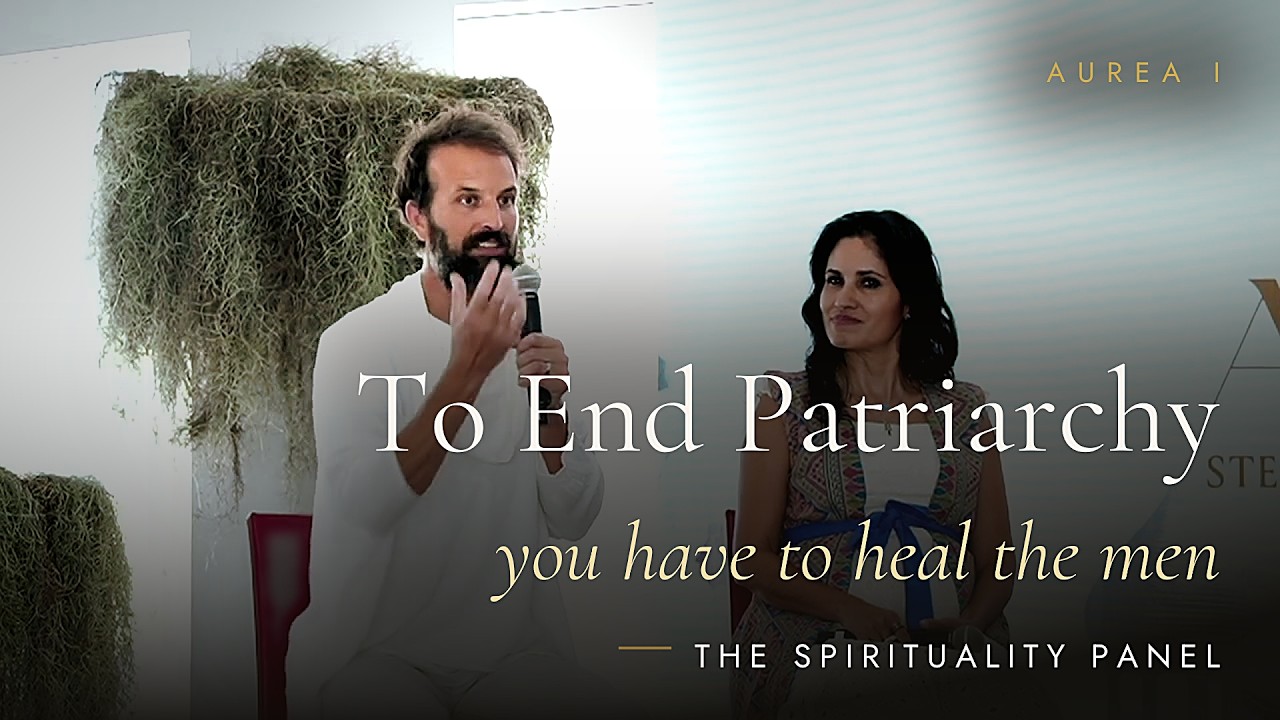
Her turn on it came in a cave during a retreat in Europe. She said the spirits told her she would be healing men from now on. She argued back that she was in devotion to the divine feminine and worked with women. The answer she got, in her telling, was a question: "Don't you want to remove patriarchy?" The way to do that, she was told, is to heal men.
Agustina kept her answer to two sentences about integration: there is no divine feminine without embracing your masculine, and no divine masculine without embracing your feminine. Lila Lotus described it as a dance the planet is already demonstrating with day and night, sun and moon, and said the work is learning how to dance your own song, because no two people carry the same arrangement. Mike Winner answered with what he does. He left a producing career in Hollywood, moved his family to the woods, and became a volunteer firefighter, something he says he never imagined five years earlier. For him the divine masculine is embodied through love and service, and he wanted it stated plainly that the love principle driving creation requires both poles in balance.
The session ended the way it opened, with attention on the room rather than on the stage. The panelists were asked for ten seconds each on where to find them, and then the audience was thanked for reflecting back what the moderator called the power of your inner leader. Agustina left one standing invitation: a free Meditation on Twin Hearts, offered every Sunday as a service for the planet.
Watch the full talk above.
Frequently asked questions
Who was on the spirituality panel at AUREA I?
Four teachers. Agustina, a pranic healing instructor with the Institute of Inner Studies and spa director of Tierra Santa Healing House at the Faena. Natalia, a facilitator of psychedelic breathwork and retreats for leaders, formerly in a tech startup. Lila Lotus, a Bolivian curandera who leads San Pedro journeys and trains healers. And Mike Winner, co-owner of Alfa Vedic and host of the Alfacast podcast.
What is the Meditation on Twin Hearts?
A meditation from the pranic healing tradition of Master Choa Kok Sui that works with two energy centers, the heart and the crown. Agustina led a short version to open the panel: smile to your heart, connect with your crown, then hold your hands out at chest height and bless the planet with peace, forgiveness and joy. She offers a full version free every Sunday.
What is pranic healing?
An energy technique taught by the Institute of Inner Studies in the Philippines, built on prana, the life force carried in breath. The practitioner scans the patient's energy body, cuts cords to other people, assesses whether each chakra is congested or depleted, removes stagnant energy and replaces it with fresh energy. Agustina describes it as complementary, meaning it accelerates a healing process the person is already running.
How do I find a spiritual path through my own ancestry?
Lila Lotus tells students to research what their ancestors sang, what rituals they kept, what they ate, and to follow that. Her argument is that the country, family and roots you were born into were chosen before this life and are therefore the most direct route available. She went back to Bolivia after twenty years abroad and slept in the mountains with indigenous elders to do it.
What did the panel say about the divine masculine and divine feminine?
That neither rises without the other. Agustina said there is no divine feminine without embracing your masculine and no divine masculine without embracing your feminine. Natalia rejected the strand of feminine spirituality that attacks men, and said she was told in a cave in Europe that healing men is how patriarchy actually ends. Mike Winner said he embodies it through service, including volunteer firefighting.
Back to Wisdom