
Tia Kansara and John Stuart Reid at AUREA: The Heart Coherence Experiment Across the Atlantic
Dr Tia Kansara, an economics and technology adviser, and acoustic physicist John Stuart Reid ran a live experiment from the AUREA II stage: seven minutes of group Om chanting in Miami aimed at a CymaScope in a UK lab, with both presenters saying plainly that the session was uncontrolled and that no result was established in the room.
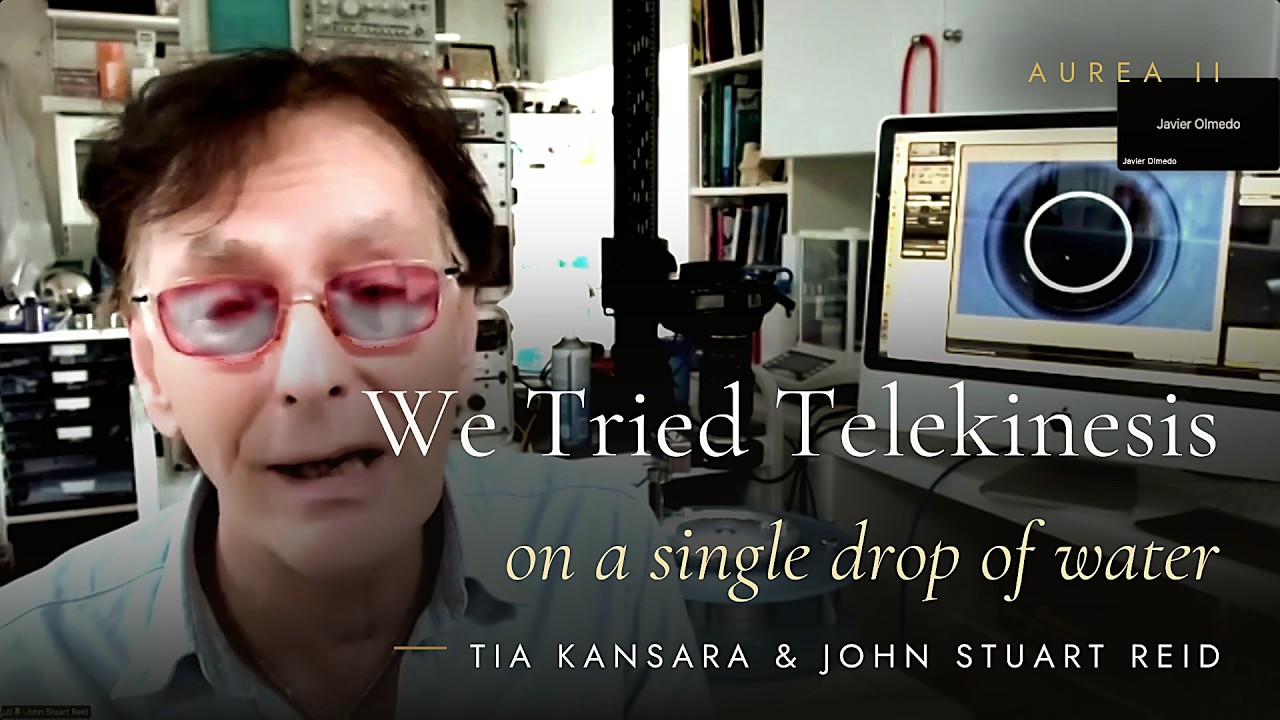
The room stood up, put a left hand on the heart, and chanted Om for seven minutes while crystal and Tibetan bowls sounded behind them. Across the Atlantic, in a laboratory in the United Kingdom, a webcam pointed down into a few drops of water in a quartz dish, and the acoustic physicist watching it waited to see whether the pattern on the surface would change.
Dr Tia Kansara led the session from the AUREA II stage. Her background is in economics, science and technology, and she was open with the room that she had never run anything like this before. Her collaborator John Stuart Reid joined live from his lab, where he builds and runs the CymaScope, an instrument that makes sound visible on water. What follows is a record of an attempt. No result was established in the room, and both of them said so out loud.

What the experiment across the Atlantic actually attempted
The attempt was this: a room of people in Miami would hold a shared intention for seven minutes, and see whether the geometric pattern standing on the surface of water in Reid's UK lab changed shape. Reid photographed the pattern before the meditation and again at the end, so the two images could be compared later by someone else.
He set the target precisely. "You guys are all going to attempt to change the fold order, that is how many aspects of the geometry, how many sides the geometry has, in the cymatic pattern that I will bring up on the screen." He was equally precise about the frame around it. He described telekinesis as "the power of the mind to move objects without contact, without physical contact," said many experiments have been run on it over the decades, and added that in his view "none of them really have been sufficiently robust, let's say, from a scientific viewpoint, to be accepted by mainstream science as a real phenomenon." He then stated his own position plainly: "I certainly believe in telekinesis. I've seen aspects of it myself." Belief and evidence stayed separate for the whole session.
What a CymaScope is and how it works
The CymaScope is an instrument that turns sound into a visible pattern on water. At its center sits a small cuvette of fused quartz with a black quartz bottom, holding a very specific volume of water. A light ring points down into it, and a camera looks down through the ring, so what appears on screen is light reflected off a living water surface.
Reid's argument for why laboratories use it, rather than the more casual cymatics setups that circulate online, is calibration. "The CymaScope instrument is a calibrated instrument, that is to say that the normal resonances in the various components of the CymaScope are identified and then the resonances are choked out electronically, so when you put whatever sound you put into the CymaScope, you get a flat response and an accurate output in terms of what we term a CymaGlyph, which is our word for sound pattern."
He also explained a detail the audience could see and might misread. The image on screen shimmers constantly. That scintillation is normal, he said, because at the boundary of any body of water there is a layer known as exclusion zone or structured water, and the wavelets moving out to the edge and reflecting back carry some of it across the surface. A dynamic standing wave looks alive even when nothing is happening to it. Introducing him, Kansara credited the instrument with a wider research use, including work that distinguishes the sounds emitted by cancer cells from those of healthy cells.
How Tia Kansara moved from economics to a coherence experiment
Kansara traced the turn to a single day about a year before AUREA II. She had built her career in what she called the logical field of science, technology and the economy. Then she sat for an akashic reading, and the reader told her that she was an akashic reader herself.
At the second session, on Valentine's Day, the reader refused to explain anything and told her to close her eyes, say the prayer, and describe out loud whatever came. "For a good 45 minutes I don't know where it all came from, but I saw visuals. I thought I was imagining it all." Her reading of what happened is that senses she had not used were waking up, the ones described in the esoteric tradition as clairvoyance, clairaudience, clairsentience and claircognizance. She framed the whole session around what she calls the bridge between matter and energy. "This coherence happens between both the physical of what we know and the etheric of which we cannot see." The experiment, in her words, was a way to tap into that coherence as a group rather than alone.
What the room was asked to do for seven minutes
The practice was a guided group meditation, not a visualization exercise done in silence. Everyone stood, shook out the body, and moved attention slowly from the feet upward, noticing and releasing whatever the scan turned up. Then the left hand went onto the heart to find the pulse.
Kansara's instruction was that a couple of seconds is enough to feel your own heartbeat, and a couple more for a room to synchronize to it. Three deep breaths in and out. Then a continuous Om chant on a circular breath, taking the inhale for as long as the exhale, at each person's own pace, while a sound practitioner played Tibetan and crystal bowls. The largest bowl sounds an F, which Kansara described as the heart note.
Over the chanting, she spoke the intention: "With our intention and with our chanting we are connecting across the Atlantic through a quantum field." She named the room, the instrument, the distance and the aim out loud, then brought everyone's attention back to the heart and closed with a final message sent to the lab.

What John Stuart Reid reported when the seven minutes ended
He reported an impression, and refused to call it a result. The images were in the lab computer and he could not display them live, so nothing was shown to the room and nothing was measured on stage.
His words: "What I saw with my own eyes was, in the last minute or so of the meditation, there was definitely more activity." Then: "It looked like to me in the last minute or so it was starting to shimmer quite a lot more than it had at the beginning, so I think we may have a result. I'm not sure." He said he would send the before and after files to the professor he collaborates with, who would compare them using a Planckian distribution equation to test whether any difference between the start and the end is significant. He closed with "fingers crossed, you know, fingers crossed everyone." That is where the matter stood when the session ended, and no analysis was reported back to the room.
Why both of them called this a practice run rather than proof
Neither presenter claimed the experiment demonstrated anything. Reid said it before the meditation began, when the outcome was still open, which is the point in a demonstration where honesty costs something.
"Listen, you know, this is a fun experiment, it's not highly controlled, but we do indeed in the future intend to conduct highly controlled experiments," he told the room, "so regardless of the outcome today, in the future we are going to be conducting similar experiments, but in a very, very controlled manner. So let's just have some fun today and just see what happens." Kansara said the same thing afterward in her own words, calling it a practice session and an introduction to the CymaScope, and pointing to a second experiment with more scientific rigor still to come. A room of people chanting together at an instrument on another continent is a real event. Whether it moved anything is an open question, and it was left open.
What earlier consciousness experiments John Stuart Reid described from the stage
Reid described two prior experiments as background, both of them his own account rather than data shown in the room. The first involved roughly two thousand people online, convened by a filmmaker he had worked with, sending loving intention toward human blood held in an incubator in his lab.
His account is that a control sample was kept in a Faraday cage, a small enclosure that screens out electromagnetic fields, and that red blood cell counts rose sharply in both the incubator and the shielded sample. He posed the question rather than answering it: how would the consciousness of two thousand people reach inside an electromagnetically screened cage at all? He credited related work on using music to extend the longevity of human red blood cells to the professor he collaborates with.
The second involved the author Lynne McTaggart, who ran an online event for the people of Beirut after the explosion in the harbour. She used the word intention three times, once before the guided meditation, once during, and once after. Reid downloaded the three voice files, injected each into the CymaScope, and reported what he described as a dramatic increase in the coherence of the patterns across the three. Kansara showed those images as slides and connected them to the water crystal photography of Masaru Emoto. Read them as claims made by the speakers on stage, offered as reasons to run better experiments.
The session ended with an invitation rather than a conclusion. Kansara told the room about an experiment planned for October inside the chambers of the pyramids in Egypt, said the whole process would be documented, and offered the before and after images from the AUREA II attempt to anyone who wanted them. What the room got that morning was the experience of trying something together while a scientist watched a dish of water and told the truth about what he could and could not see.
Watch the full talk above and learn more about John Stuart Reid's work.
Frequently asked questions
Did the telekinesis experiment at AUREA II work?
No result was established. John Stuart Reid could not display the images in the room and did not claim an outcome. He said he thought he saw more shimmer in the final minute of the meditation, immediately added "I'm not sure," and said he would send the before and after photographs for analysis using a Planckian distribution equation. He had already told the room the session was not highly controlled.
What is a CymaScope?
An instrument invented by acoustic physicist John Stuart Reid that makes sound visible as a pattern on water. Sound energy is fed into a small fused quartz cuvette holding a precise volume of water, lit by a light ring and filmed from above. Reid's case for it is calibration: the instrument's own resonances are identified and electronically choked out, so the output pattern, which he calls a CymaGlyph, reflects the input sound.
What did the AUREA II room actually do during the experiment?
Everyone stood, shook out the body, scanned attention from the feet upward, and placed a left hand on the heart to find the pulse. After three deep breaths came seven minutes of continuous Om chanting on a circular breath, accompanied by Tibetan and crystal bowls, with the largest bowl sounding an F. Dr Tia Kansara spoke the shared intention aloud over the chant.
Who are Tia Kansara and John Stuart Reid?
Dr Tia Kansara led the session at AUREA II. Her background is in economics, science and technology, and she described a shift toward esoteric work after two akashic readings the year before. John Stuart Reid is an acoustic physicist who invented the CymaScope and joined live from his laboratory in the United Kingdom to run the water and instrument side of the experiment.
What happens next with these CymaScope experiments?
Reid told the room that future experiments will be run in a very controlled manner, and that the AUREA II images would go to a collaborating professor for comparison. Kansara described a second, more rigorous experiment already planned, and an October project inside the chambers of the pyramids in Egypt, with the entire process documented. Both invited attendees to follow the work or take part.
Back to Wisdom