
Vishen Lakhiani at AUREA: Money Is Not the Opposite of Spiritual
The Mindvalley founder took the AUREA stage, asked the room to vote between two talks, then deliberately gave the one that lost, because that was the one they needed. Four beliefs for people who are spiritual and broke.
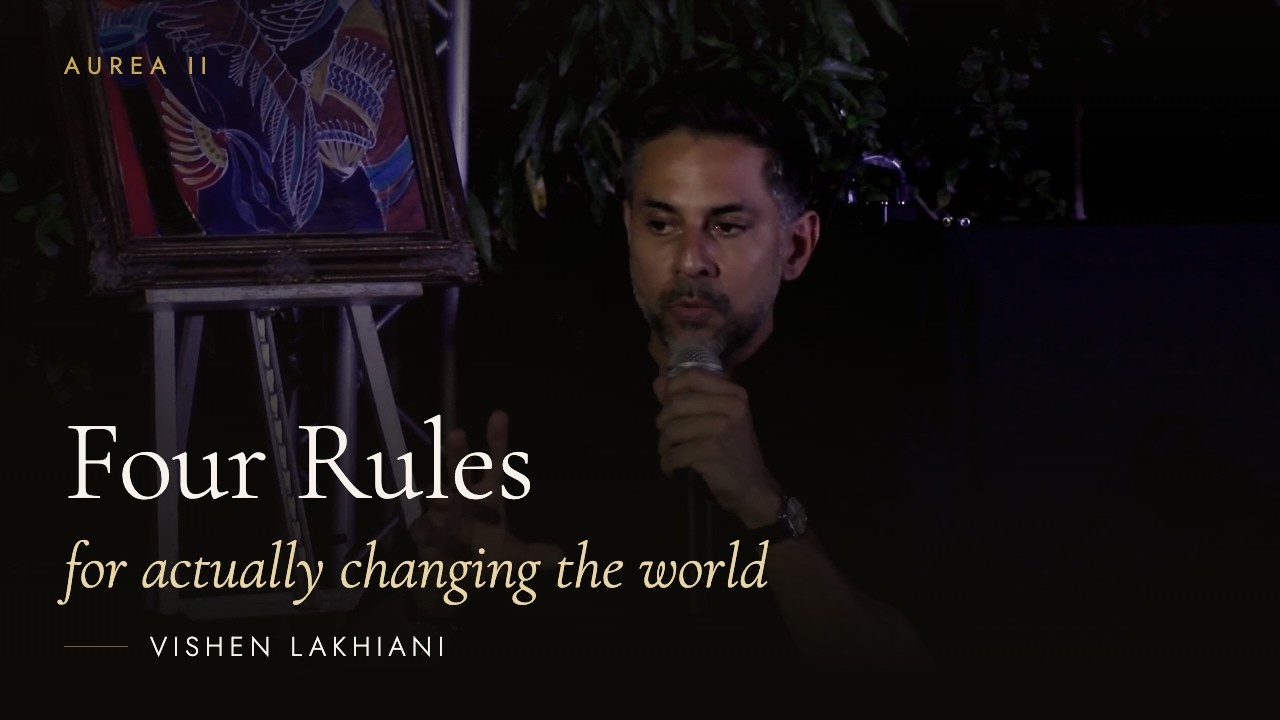
Vishen Lakhiani did not plan to speak. He came to be with friends, got asked, and submitted a talk called Four Ways to Rule the World.
Word came back: not that one. This is a spiritual community. Too coercive. Too masculine. Too powerful.
So he submitted The Four Levels of Consciousness instead. Then he arrived and was told these are entrepreneurs who want to change the world. Give the first one. Then someone else said give the second.
He walked on stage and put it to a vote. Then he gave the talk that lost.
"I'm going with the talk that got the least number of hands raised because that's the talk you need to hear. If I tell you what you already know, I'm not doing you the justice of occupying your time."
What accusation he made against the spiritual community
He named the problem in the room without softening it. Spiritual people, he said, get obsessed with the yoga mat and forget that the point is to get off it and make an impact, one measure of which is the wealth you create.
Then he took direct aim at something another speaker had said earlier: a shaman who reportedly refuses to work with anyone worth more than ten million dollars, on the grounds that they are hoarding.
"I think that is absolute rubbish. And that attitude is what keeps so many spiritual people broke."
He leaned on Ken Wilber's essay Egolessness for the backing: the great sages were not "feeble-minded milquetoasts." They were movers and shakers who rattled the world with the force of their ambition, not by avoiding the human, physical, ambitious dimensions of themselves, but by engaging them hard enough to shake the foundations. That essay became his book, The Buddha and the Badass.
Point one: why money and power are not evil
Money and power are energies. Like any energy they can be aimed well or badly, and most of the genuinely wealthy people he knows aim them well. He has signed the Founders Pledge, a public commitment to give it away as he makes it. You cannot give away what you refused to build.
Two: hard work and success are not correlated
This is where the talk stops being theory and becomes his life.
His mother drove two hours each way to teach school in Malaysia for four hundred dollars a month. His father ran a textile factory, and Vishen worked in it after school, hauling boxes onto trucks. One night his father came home at 10pm, said hello, and fell backward onto the floor. He had worked himself to collapse.
So the belief went in: hard work equals success.
Years later, newly a father himself, Vishen cut one hour a day to be home with his one-year-old son. The belief did the rest. Mindvalley started sliding until there were three months of runway left and eighteen jobs on the line.
"What you believe about the world will be your world. It's all an illusion, and our beliefs are what programmed that illusion."
He sank into a depression, which he now describes the way Michael Beckwith does: a kensho moment, the universe kicking you awake because you were too stubborn to listen. In the middle of it he read T. Harv Eker's list of beliefs that keep people broke. One of them was that hard work is necessary for success. He wept, and he says everything changed in eight months. Revenue up eight hundred percent, and the company you now know as Mindvalley came out of it.
He also passed on the advice a Dubai billionaire gave him on a balcony overlooking the Palm Jumeirah: work twenty-one hours a week. Seven hours Tuesday, Wednesday, Thursday. Keep Monday and Friday open for opportunity.
"Your work will expand to exactly how much you dedicate to it."
Point three: how he splits his year in two
He does not work past 8pm, no matter what is happening. And he runs his year in two modes: months of full acceleration inside the business, then months of navigation. Travelling, meeting, staying open, letting the next idea and the next partner find him.
He was on the fourth festival in four months when he gave this talk, while running a company of four hundred people. That is not a break from the work. It is the other half of it.
Four: there is no such thing as a problem
His teacher caught him being reasonable about hardship. Every problem has a lesson, I solve them, it's all good. She stopped him.
Imagine someone bragging that they recover from every cold in 24 hours. Good belief. But it still contains the cold. What if the belief didn't?
So he replaced it with a single line he repeats every morning in meditation:
"I solve every problem that comes my way in a fun and easy way."
Lost a key client? Not a problem. Missed a target? Not a problem. Arrived to give a talk and found he had no slides and no idea which talk to give? Not a problem.
What this means for people who think building is beneath them
The people best equipped to build the companies the world now needs are frequently the ones who have decided that building is beneath them. Money is dirty, power is corrupting, and ambition puts holes in your aura, they believe.
Vishen's whole talk is an argument that this belief is not humility. It is a cage, and the only person locked in it is you.
Watch the full talk above.
Frequently asked questions
What talk did Vishen Lakhiani actually give at AUREA, and why?
The room voted between two of his talks and picked the one with fewer raised hands; he explained that's the one they needed to hear, since telling people what they already know doesn't do them justice. He then argued spiritual people often get obsessed with the yoga mat and forget the point is to make an impact, including building wealth.
Does he think hard work leads to success?
No; he calls hard work and success uncorrelated, citing his own father collapsing from overwork. When Vishen cut an hour a day to be with his newborn son, his company Mindvalley nearly failed until he confronted the belief that hard work was necessary, after which, he says, revenue rose eight hundred percent in eight months.
What is his "no such thing as a problem" practice?
A morning meditation line he repeats: "I solve every problem that comes my way in a fun and easy way." The idea is that even reasonable beliefs about hardship still contain the hardship; better to remove the frame of "problem" entirely than to just get good at solving them.
How does he structure his working year?
In two modes: months of full acceleration inside the business, then months of what he calls navigation (travelling, meeting people, staying open so the next idea or partner can find him). He was on his fourth festival in four months, while running a company of four hundred people, when he gave this talk.
Back to Wisdom