
Zack Blakeney at AUREA: The Hypnosis You Don't Know You're Under
Zack Blakeney, founder of Born Free, told the AUREA III room why he calls the phone your number one hypnotist, drew the dopamine spike-and-drain cycle on a whiteboard, and gave four questions for finding your shadow plus the four-step forgiveness intention he uses to release a pattern.
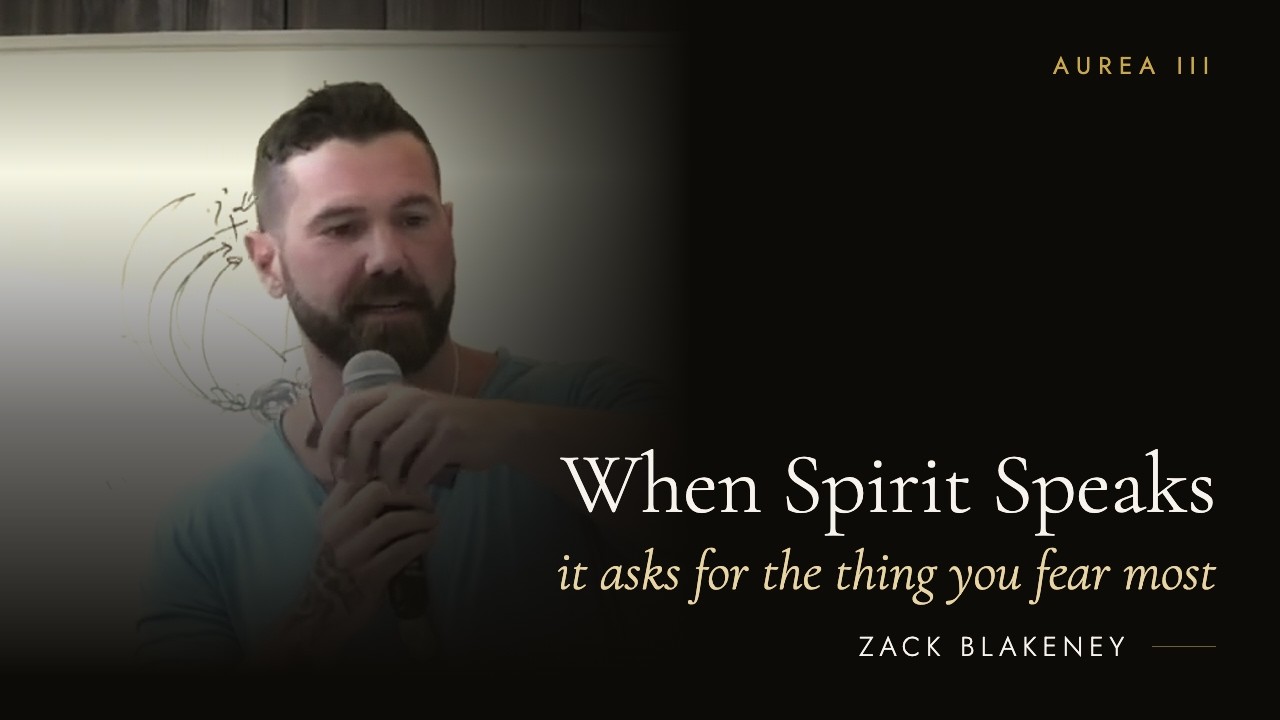
Zack Blakeney asked the AUREA III room a question with an obvious answer. Have you ever been hypnotized? A few hands went up. "You guys should all be raising your hand," he said, and held up a phone. "This is your number one hypnotist. And you've been hypnotized for the last 20 years without knowing it."
Blakeney runs Born Free, a practice built on the idea that a person is born sovereign, and he teaches through the hermetic principles and a whiteboard he draws on while he talks. This talk had three moving parts: what unconscious screen time does to the nervous system, how to find the beliefs running underneath it, and the forgiveness process he uses to clear them. He also gave the room a live diagnostic, and made people say their score out loud.

Why he calls your phone your number one hypnotist
His claim is that unconscious scrolling puts you into a suggestible brainwave state while content writes itself into your subconscious. He calls it hypnosis because you did not choose the suggestions and you cannot recall receiving them.
He drew the mechanism on the whiteboard as a line. The middle is regulated dopamine. Screens arrived, and the line started spiking and draining, spiking and draining, over and over, every time a phone comes out of a pocket. His list of what dopamine governs was long: reward processing, motivation, movement, attention, pleasure, mood, cognitive function, memory, and vital energy. "This biochemical is the regulator of your nervous system, and it is out of whack as a collective," he said.
The consequence he cared about most was receptivity. A person cannot arrive at a relaxed, receptive nervous system through unconscious scrolling, because the scrolling is the thing dysregulating it. He also named the loop underneath: people reach for the phone to avoid something uncomfortable, and then, still inside that state, start finding the content that confirms it. Twenty years of that is twenty years of reinforcement.
Then he made it personal in the room. He put a QR code up, gave everyone two minutes to take a dopamine quiz, and asked for a show of hands by color. Red. Yellow. Green. "There's no shame here. There's just recognition," he said. "That quiz is just a mirror of what's happening in your unconscious." His two questions afterward were why you are choosing a screen over yourself, and what patterns you are avoiding and reinforcing at the same time.
Why he built this teaching after his engagement and his business ended
The material came out of the worst year of his life, and he told the room the sequence in order. About nine months before AUREA III, sitting in a peyote ceremony at a men's retreat, he heard something he did not want to hear: that he could not become who he was meant to be with the woman he was with.
She was his fiancée of five years. They had built a business together that he says collected half a million dollars in revenue in its first year. He left the retreat angry at God, tried to rationalize the message into something smaller about restructuring the business, and then watched his own shadow do the work for him. He broke a foundational agreement of the relationship, in a way he says he knew would end it, and it ended it.
What followed he calls the grief portal. An abandonment wound he thought he had healed came back as a five-year-old who wanted to be loved without performing for it. Then a furious fourteen-year-old. Then a father wound he had been sure he did not have. In the middle of it he went to his phone to stop feeling it, and one day he was on it for eight hours. That was where he saw an ad about dopamine dysregulation and recognized his own symptoms in the list. His reading of that moment is that it was an assignment: to go through the pain so he could name a hypnosis that even people doing deep inner work are still under.
The four questions he uses to find your shadow
Blakeney gave the room four core wounds and a question for each, designed to be run as a monthly inventory. Hiding, which he says is a symptom of shame. Denying, which is repression. Lying, which is guilt. Trying, which is separation.
His arguments for each were short. There is nothing you hide that you do not feel some shame about, and the hidden things are the ones that keep the suffering running. What you deny, you empower to exist, because the denial is the energy holding it there. Lying is the sneakiest of the four: when someone asks whether you are all right and you say you are fine, you are rejecting the support you actually want and taking away the other person's chance to give it. Trying is being someone you are not.
The four questions: What am I hiding from others that I don't want them to know about me? What am I saying I don't want that I actually have? How am I lying to myself and others? Who am I trying to be that does not align with my soul? He says he derived them from his own recovery after 16 years of pornography addiction, where he found he had done all four. "The real addiction is the addiction to not being yourself," he told the room. His note on what happens next matters: the shadow does not disappear the way people expect it to, and the instruction is to integrate it rather than deny it.
How he turns a limiting thought into an empowering one
His method uses the hermetic principle of polarity, which holds that opposites are two degrees of the same thing. A limiting thought sits at one end of a scale, and the way to move it is to loosen the protection around it rather than argue with it.
He demonstrated it live. Someone in the room offered the thought "it's too late." He put it at the far negative end of a line running from scarcity to abundance, then asked the question he uses to loosen it: "How does it benefit me that it's too late right now?" You list benefits, as many as you can, and keep going. Each one drains a little charge out of the thought and opens the other pole. Out of that list, he says, your own consciousness produces the empowering belief, and it is more specific than anything you would have chosen in advance.
The four steps he gave: become aware of the limiting thought and write it down; neutralize it with as many positive benefits as possible; create the new empowering belief; then reaffirm it daily until it holds. His timeline was 21 days before synchronicities start showing up. What he says this produces is a state of resolve, where the conscious and subconscious minds agree that the pattern no longer serves who you are becoming, and the mind stops arguing. Once the mind stops arguing, he says, the body feels safe enough to release.
What the plane of cause is, and why working on effects does not hold
Blakeney separates the plane of effect, where your thoughts and behaviors and circumstances live, from the plane of cause, the level of consciousness generating all of them. His argument is that people spend years fixing effects and keep producing the same life, because the cause was never touched.
He mapped his own as proof, using a scale of consciousness that puts shame at the bottom at 20. Failing French in seventh grade in a family that expected good grades. Watching pornography for the first time at fourteen, raised Catholic, where it counted as a sin. Hitting a wall as a college baseball player after being good at the game. A divorce at thirty. Four events that look unrelated, and he read the same source under all of them: shame.
Then he drew the loop. The body registers shame, because in his framing the body is built to carry love and will flag anything else for release. The mind refuses to feel it and pushes it back down. Now it is held in the body, radiating outward, and the world answers with a matching experience. That experience produces more shame, and the cycle tightens. He used dating as the everyday version: a new person who seems completely different from the last one, and then it turns out to be the same relationship, because the plane of cause did not change.
The four-step forgiveness intention he says releases the pattern
The step Blakeney says makes the difference is aiming forgiveness at the cause rather than the behavior. He says he tried to forgive himself for watching pornography hundreds of times, felt temporarily better each time, and had to do it again. What finally moved was forgiving himself for shaming his own sexuality.
The setup was ordinary: a bath, Epsom salt, incense, a candle, a quartz crystal, hands at prayer center. The intention came in four parts. "I intend to forgive myself for choosing to shame my sexual expression." Then: "I willfully accept all things needed for my intention to become manifest. All things are possible through you, Father. And so it is." He says what followed was crying from the root and sacral while images left his field, and then laughing at how absurd sexual shame is, both poles in one sitting, and then it was gone.
He says he has since taken more than 50 people through the same process, and that he has done it with plant medicine and without it. He was direct about how his pornography addiction finally ended: the release came when he became convinced that what he was participating in was spiritually hostile rather than merely a habit, and that conviction is his own.
The last chapter of the story he told was the hardest. The grief pushed his body into hypervigilance, waking him at two in the morning with cortisol and dread, and he began revisiting suicidal thoughts for about a month. A friend invited him to a psilocybin retreat. The night before, awake again at two, he heard that what he needed to forgive was not trusting God, and he ran his four-step intention on that. During the ceremony he admitted out loud, for the first time, that he had lacked the courage to follow what he was called to. He says he then purged three times on the floor, stood up, and found the suffering gone.
How to forgive someone who actually hurt you, in his framing
A woman in the room asked the harder version of the question: how do you forgive an actual person, a partner or a parent, deep enough that the body lets go. His answer was that you take responsibility for your part in the relationship that hurt you.
He worked it through with her rather than leaving it as a slogan, and he named the risk in it himself. He was not asking her to excuse what was done to her. His position is that responsibility begins the moment you become conscious of your own thoughts. He asked her what she was holding toward her mother. Anger. He asked what the anger was doing to her nervous system. Not treating her well. His instruction was to point the forgiveness at her own choice to hold it.
What he says happens next is the part he has seen repeatedly in his retreats. People who did this have a parent reach out and apologize without being asked. His explanation is that the field changed first.
He closed with the parable of the footprints in the sand, and made a point of saying it was not his story. A man reviewing his life sees two sets of footprints, then only one during his darkest stretch, and asks why he was abandoned. He was carried. Blakeney's addition was about where the responsibility sits: the path of becoming a co-creator of your own experience is yours to walk, and there is a whole other thing that moves through you once you have the courage to trust life.
Watch the full talk above.
Frequently asked questions
What does Zack Blakeney mean by the hypnosis you don't know you're under?
He means unconscious phone use. His argument is that scrolling without attention puts you into a suggestible brainwave state, so content writes into your subconscious without your consent or recall. He calls the phone your number one hypnotist and puts the exposure at roughly 20 years for most adults. The knock-on effect he cares about is dopamine, which he describes as the regulator of the nervous system.
What does he say screens do to dopamine?
They spike it and drain it, repeatedly. He drew a regulated baseline on the whiteboard and then a jagged line above and below it, which happens every time a phone comes out for a mindless scroll. He listed dopamine as governing reward, motivation, movement, attention, pleasure, mood, memory and vital energy, and argued you cannot reach a receptive, relaxed nervous system while dysregulating it this way.
What are the four questions for finding your shadow?
What am I hiding from others that I don't want them to know about me? What am I saying I don't want that I actually have? How am I lying to myself and others? Who am I trying to be that does not align with my soul? They map to hiding as shame, denial as repression, lying as guilt, and trying as separation. He recommends running them as a monthly inventory.
How does his thought alchemy process work?
It uses the hermetic principle of polarity. Write down the limiting thought, then ask how it benefits you right now and list as many benefits as you can, which drains the charge holding it in place and opens the opposite pole. An empowering belief surfaces out of that list. Reaffirm it daily. He says roughly 21 days in, synchronicities start showing up.
What is the four-step forgiveness intention?
Aim it at the cause rather than the behavior, name it, then say: I willfully accept all things needed for my intention to become manifest, all things are possible through you, Father, and so it is. His own example was forgiving himself for choosing to shame his sexual expression, after hundreds of failed attempts to forgive the behavior itself. He says he has run more than 50 people through the same process.
Back to Wisdom