
Austin's Healing Scene Has a Displacement Problem
Austin rents are falling and evictions keep climbing. The city's wellness and founder scene grew up on East Austin land that longtime families lost, and it is time we said so and did something about it.

Austin rents have been falling for more than a year. Evictions have kept climbing anyway. The city's wellness and founder scene grew up fastest in the same East Austin neighborhoods that lost the most longtime residents, and most of us who work in that scene have never said so out loud. We should. A healing culture that ignores who was priced out of the neighborhood it heals in is only half awake.
This piece is for the founders, coaches, healers, and investors who moved to Austin, or grew up here, and love what it has become. It lays out what the data says about housing and displacement right now, where we think the conscious-business world is getting it wrong, and what anyone can do about it this year.
Is Austin still getting more expensive?
Austin rents are going down, and home prices are well below their peak. Realtor.com put the city's median asking rent at $1,371 in June 2026, down 4.3 percent from a year earlier, after a building wave that the Austin Apartment Association says added about 86,000 rental units since 2023.
That is real good news, and it came from building. It also hides two things. The decline is slowing: Apartment List data shows rents were falling about 6 percent a year in September 2025 and about 2.3 percent a year in September 2026. And cheaper rent on average does not reach the people who were already behind.
The city's median household income was $90,430 in 2024, down 1.2 percent from the year before. Incomes are not rising to meet the relief. For a family one missed paycheck from the edge, a slightly lower rent on a new tower downtown changes nothing.
Why are evictions rising in Austin while rents fall?
Evictions in Travis County are rising because the people being evicted were never the ones the new luxury supply was built for. Falling average rents help renters who can move. They do little for a household that already owes two months.
The numbers are stark. Travis County recorded 13,209 eviction filings in 2024, the most since at least 2014. By August 2026, Eviction Lab data showed more than 15,600 filings in the most recent 12 months, 35 percent above the 2023 to 2024 average, or about one case for every 20 renter households. The tenant group BASTA reports that more than a quarter of requested judgments are for less than $2,000.
A filing is not the same as an eviction, and a judge still has to rule. But a filing alone can follow a renter for years on screening reports. Less than $2,000 is a car repair, a hospital visit, or a slow month at a service job. In a city that just added tens of thousands of homes, that is the gap where people fall out.
Who was pushed out of East Austin?
Low-income Black and Latino families were pushed out of East Austin, and the research on it is not ambiguous. The University of Texas study Uprooted, commissioned by the City of Austin and published in 2018, mapped 16 neighborhoods actively gentrifying and 23 more vulnerable to it, in an arc from North Austin through East Austin to the eastern edge of South Austin.
The authors, Heather Way, Elizabeth Mueller, and Jake Wegmann, found "an alarming loss of low-income persons of color" across that eastern crescent. Earlier work by UT professor Eric Tang showed that from 2000 to 2010 Austin grew about 20 percent while its Black population fell 5.4 percent, making it the only fast-growing major U.S. city to lose Black residents in that decade. That data is old now, and it still describes the ground many of today's studios, cafes, and co-working spaces sit on.
Why Austin's wellness and founder scene should care about displacement
Austin's wellness and founder scene should care about displacement because it is one of the ways the city now sells itself, and it grew up on land that other people lost. Austin hosted the U.S. debut of the Health Optimisation Summit in April 2025, with 2,500 to 3,000 people expected and passes starting at $339. Thermal spas, longevity clinics, breathwork studios, and conscious co-working spaces keep opening on the east side.
None of that is bad on its own. We go to these places. Some of our friends run them. The problem is a habit of mind that the wellness world is especially prone to: treating healing as a private purchase, made by people who can afford it, in a neighborhood whose history they never learned.
Here is where we will be unpopular with some of our own people. A culture that talks constantly about trauma, ancestry, and belonging, and cannot name the families who used to live on its block, has a blind spot. The practices are real. The awareness stops at the property line.
Guilt is not the answer either. Guilt makes people defensive or frozen, and neither one builds anything. The answer is to widen the circle of care until it includes the place, and then to act like it.
What the Austin boom left behind
The Austin boom left behind a city with more homes, fewer newcomers, and a lot of people who still do not know their neighbors. Domestic migration into the city peaked at about 48,000 people in 2020 and fell to about 14,000 in 2024, according to the city demographer.
That slowdown gives Austin something it has not had in fifteen years: a breath. The people who arrived during the rush are now staying long enough to decide what kind of residents they want to be. Some will treat Austin as a backdrop for their careers. Others will put down roots, and roots are always local. They grow in a specific neighborhood, next to specific people, many of whom were here first.
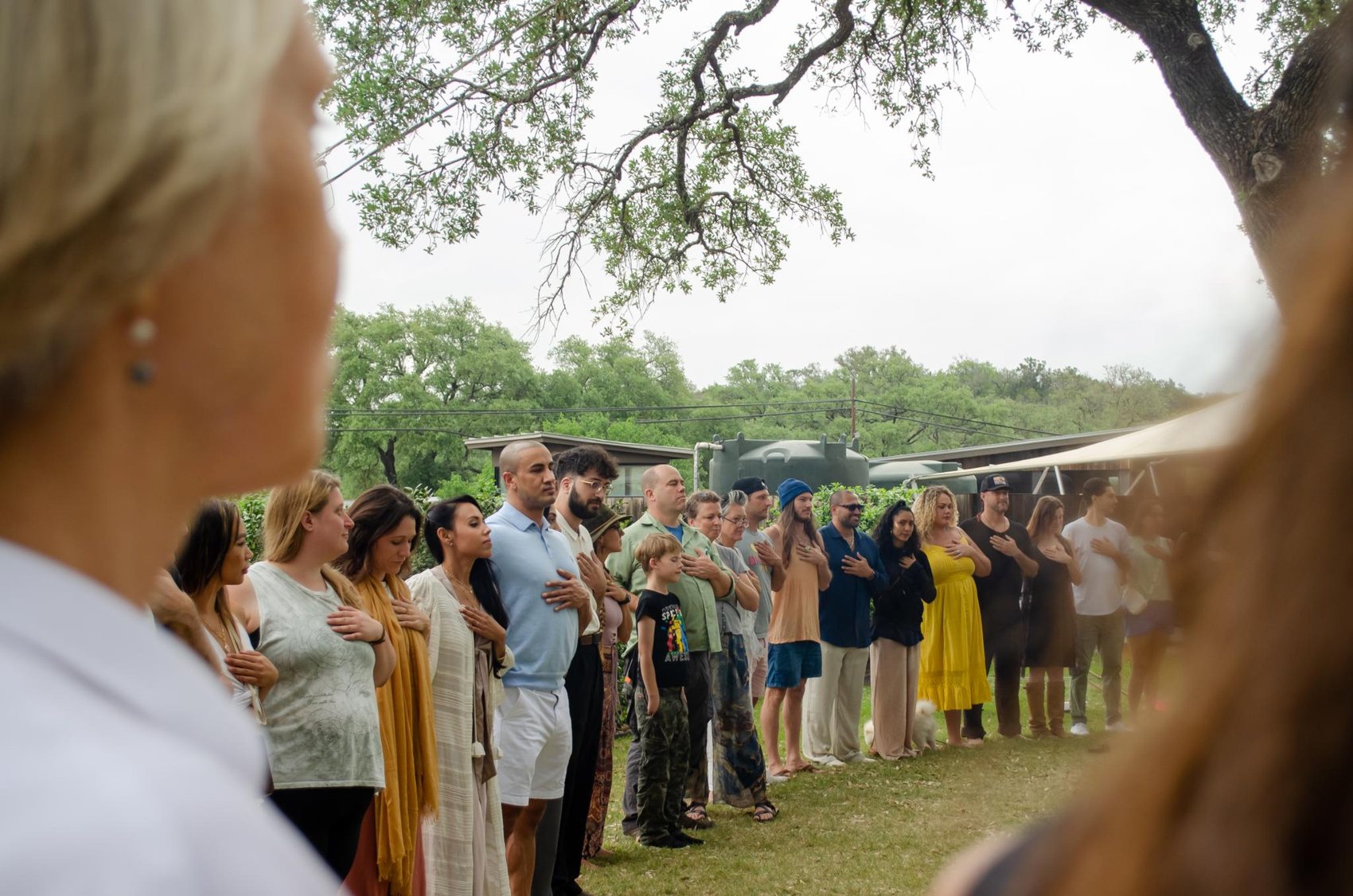
What a conscious Austin founder can actually do about displacement
A conscious founder in Austin can do five concrete things about displacement, and none of them requires running for office. Each one costs a little money or a little time, and each one makes the city more yours in the honest sense.
Learn the history of your block. Find out who lived in your neighborhood in 1990 and where they went. The Uprooted maps are public. An afternoon of reading changes how you walk down your own street.
Buy from the businesses that were there before you. The taqueria, the barber, the church fish fry, the family hardware store. Spend money with people whose roots in the neighborhood are deeper than yours, on purpose and on a schedule.
Back community land trusts. A community land trust keeps the land under a home permanently affordable while the family owns the house. East Austin's Guadalupe Neighborhood Development Corporation broke ground in 2025 on Johnny Limón Village, 27 land trust homes at 800 Gardner Road, with a land lease of $50 a month and completion expected in spring 2027. Groups like that can use donors, volunteers, and professional skills.
Hire and pay locally. If your studio, clinic, or startup employs people, pay a wage someone can live on in the zip code where they work. A wellness business that burns out its front desk is selling a contradiction.
Make room at your table. Offer scholarships, sliding scales, or community seats, and actually fill them. A room of people who all paid the same price and look the same is a market, and markets do not heal places.
"It was so important to us to have a lot of Costa Ricans. So we radically discounted many, many of the lots and made just the best terms and financing so that we can get as many Costa Rican families living there as well."
— Dr. Stephen Brooks, Permaculture pioneer & founder, Envision · AUREA I · Miami Beach 2022
Where AUREA stands on growth and displacement in Austin
AUREA stands for growth that gives back to the land and the people it takes from. We welcome the jobs, the money, and the new neighbors. We also believe that a leader's healing is incomplete until it reaches the place they live.
We hold ourselves to the same standard, and we are not exempt. Our home is 22 acres in Elgin, Texas, about 35 minutes east of Austin, in one of the fastest-growing corridors in Texas. Elgin's school district has projected it could reach about 14,500 students by 2034, up from 5,980. Growth is coming to Elgin whether we gather there or not. What we can choose is how we show up in it.
So we hold three commitments. We learn the history of the land we gather on and we tell it honestly. We spend money with the people and businesses already there. And we keep asking every project, including our own, whether it leaves the soil, the water, and the people stronger in ten years.
Underneath the titles and the zip codes, we are all the same. The longtime East Austin family, the newly arrived founder, and the healer in between want the same things: a home, a people, and work that matters. That belief is the whole reason AUREA exists, and it has to include the neighbors.
If you want to start with people instead of a plan, join the live community call with Jackson, every Monday at 9am Central. If you want to build with others on the land, come to AUREA IV: The Next Renaissance, March 26 to 28, 2027, in Elgin, Texas.
Frequently asked questions
Are rents going down in Austin?
Yes. Austin rents have fallen for more than a year after a large wave of new apartments, with the Austin Apartment Association estimating about 86,000 rental units added since 2023. Realtor.com put the median asking rent at $1,371 in June 2026, down 4.3 percent from a year earlier. The decline is slowing, though, and lower average rents have not stopped rising eviction filings in Travis County.
Why are evictions rising in Travis County?
Eviction filings in Travis County are rising mainly because many low-income renters are behind on small amounts they cannot cover, and new supply mostly helps renters who can afford to move. Travis County had 13,209 filings in 2024, the most since at least 2014, and Eviction Lab data showed more than 15,600 filings in the 12 months before August 2026. The tenant group BASTA reports more than a quarter of requested judgments are under $2,000.
What is a community land trust?
A community land trust is a nonprofit that owns land permanently and leases it to the families who buy the homes on top of it. Because buyers pay only for the house, homes stay affordable for future buyers too. In East Austin, the Guadalupe Neighborhood Development Corporation sold the first land trust home in Texas and is building 27 more at Johnny Limón Village, with a land lease of $50 a month.
What did the Uprooted study find about Austin?
Uprooted, a 2018 University of Texas study commissioned by the City of Austin, mapped 16 neighborhoods that were actively gentrifying and 23 that were vulnerable, mostly in an arc through North, East, and Southeast Austin. Its authors, Heather Way, Elizabeth Mueller, and Jake Wegmann, found low-income Black and Latino renters were being displaced and urged the city to tailor anti-displacement action to each neighborhood.
Where is AUREA IV held?
AUREA IV: The Next Renaissance takes place March 26 to 28, 2027, on a 22-acre property in Elgin, Texas, about 35 minutes east of Austin. The weekend brings purpose-driven leaders together for talks, breathwork, and small circles called Pentas, each a small circle of up to five people matched by Serafina, our companion. Meals are not included in tickets.
Back to Wisdom